

Real Estate Investor CRM: Sellers, Buyers and Deals in HighLevel
A real estate investor CRM tracks motivated sellers from the first contact to a signed contract, then matches each deal with buyers from your list. GoHighLevel covers that with two pipelines, a Property object, instant follow-up, call queues and Voice AI, at a flat price. However, it has no skip tracing, property data or direct mail, so you connect those.
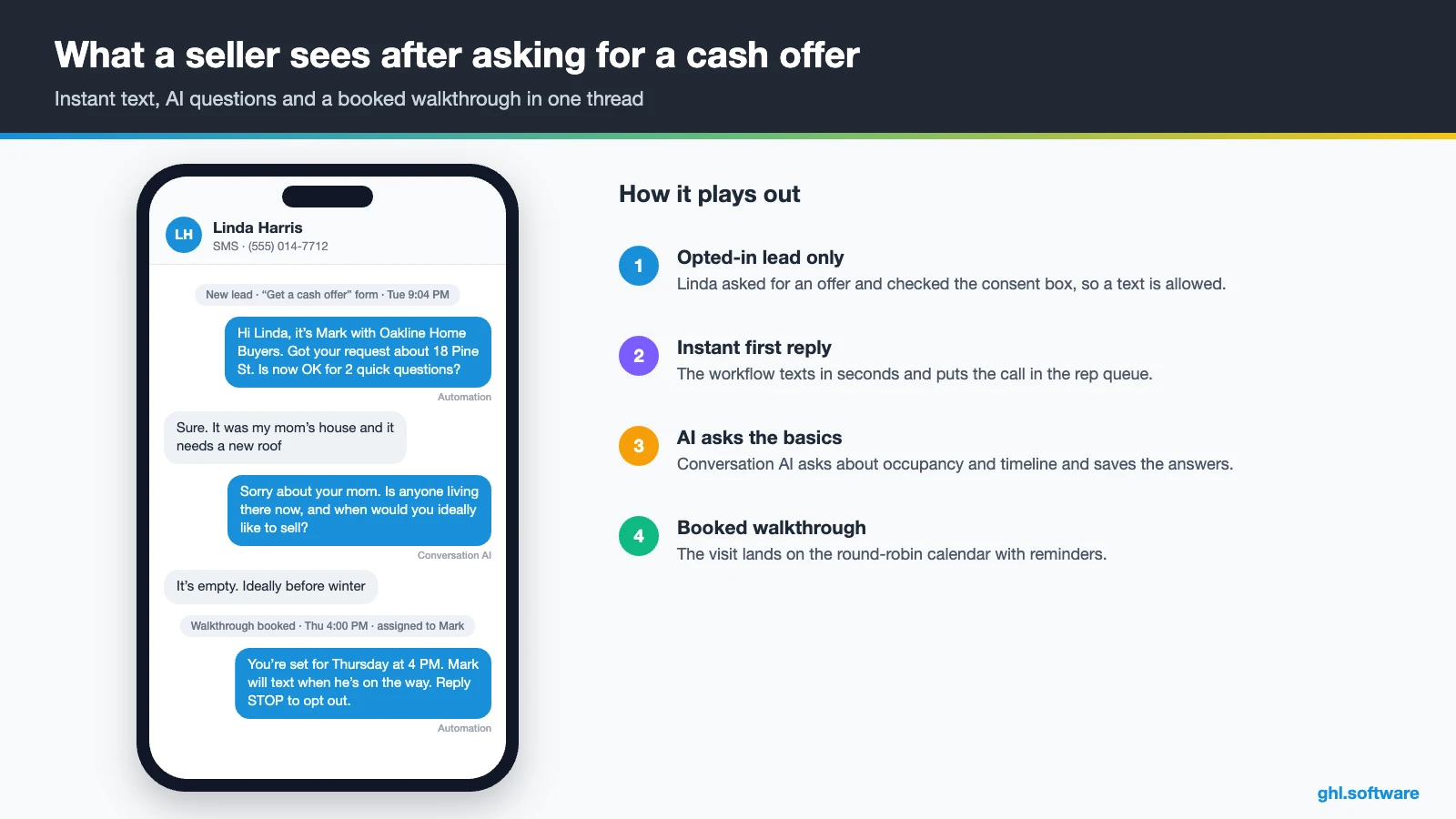
Fifty-eight seconds after Linda Harris asks for a cash offer on her late mother’s house, her phone buzzes. The text is from your El Paso team, asking if she has time for two quick questions. That afternoon, she had also called another investor’s postcard number and reached voicemail. That investor calls back the next day. By then, Linda has already booked your walkthrough for Thursday. A real estate investor CRM exists for that first minute and for the twelve months after it. After all, most sellers are not ready on the first call.
This guide is for wholesalers, flippers, landlords and small acquisitions teams, and for the agencies that build their systems. If you are an agent or a brokerage, however, our CRM for real estate guide fits better. Here, instead, we focus on the investor’s two jobs: buying from motivated sellers and selling or assigning to cash buyers.
You will see both pipelines, three automations, the setup order and the real cost. Then we cover honest gaps and texting rules, because this is an independent affiliate guide.
Leer en español: CRM para inversionistas inmobiliarios · Ler em português: CRM para investidores imobiliários · Part of GoHighLevel by industry
Includes a free live setup class with a HighLevel coach.
Start free + bootcampAffiliate link.
What a real estate investor needs from a CRM
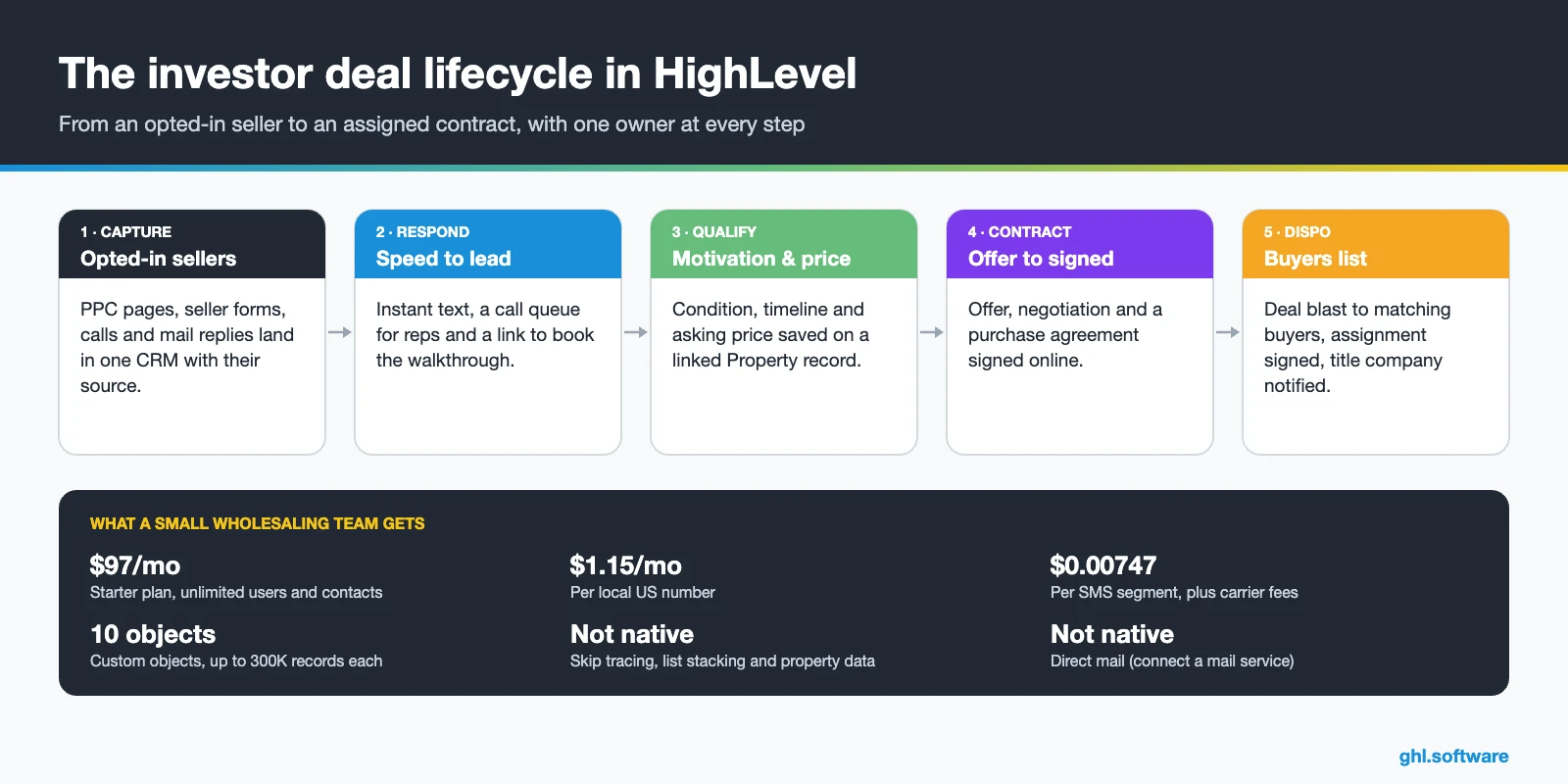
An investor’s business has two sides. Acquisitions finds owners who want to sell and gets a property under contract. Dispositions then sells or assigns that contract to a buyer whose buy box matches the area, price and property type. Flippers and landlords add a rehab or rental stage in between. So a real estate investor CRM has to track people, properties and deals at once, and keep following up long after the first call.
Real estate investor CRM or investor portal?
Search results for this topic mix two very different products. A real estate investor CRM, like the one in this guide, helps you find sellers, follow up and close deals. An investor-relations portal, on the other hand, serves syndicators and fund managers who report to their own limited partners. For example, tools such as Agora, Juniper Square or SyndicationPro handle subscriptions, distributions, documents and tax forms for those investors.
HighLevel belongs to the first group. As a result, it has no LP portal, no distribution waterfall and no K-1 handling. Still, sponsors use it for the sales side of raising capital, with webinar funnels, email nurture and a private community. In short, if you buy houses, read on; if you report to passive investors, you need a portal first.
Investor problems and how HighLevel solves them
Most investors don’t lose deals for lack of leads. Instead, they lose them through slow replies, messy lists and follow-up that stops after two calls. So the table maps each problem to the HighLevel feature that fixes it.
| Problem | What HighLevel does | Feature |
|---|---|---|
| Paid leads wait hours for a reply | Texts the seller instantly, then queues a call for the next rep | Workflows + Manual Call |
| Missed calls from mail and signs | Texts the caller back and also logs the lead | Missed call text back |
| Sellers who are “not ready” | Runs a 12-month text and email sequence that stops on reply | Workflows |
| Property details in spreadsheets | Stores each property as a record linked to the seller and buyers | Custom objects |
| Duplicates and dirty imports | Imports CSVs with tags and merges duplicate contacts | Contacts |
| Buyers list in a spreadsheet | Tags each buyer’s buy box and filters them into smart lists | Smart lists + email |
| No idea which campaign pays | Tracks source, contracts and won deals per campaign | Reporting + Forecast |
| Contracts chased by email | Sends purchase and assignment agreements for e-signature | Documents & Contracts |
The real estate investor CRM pipeline: acquisitions and dispositions
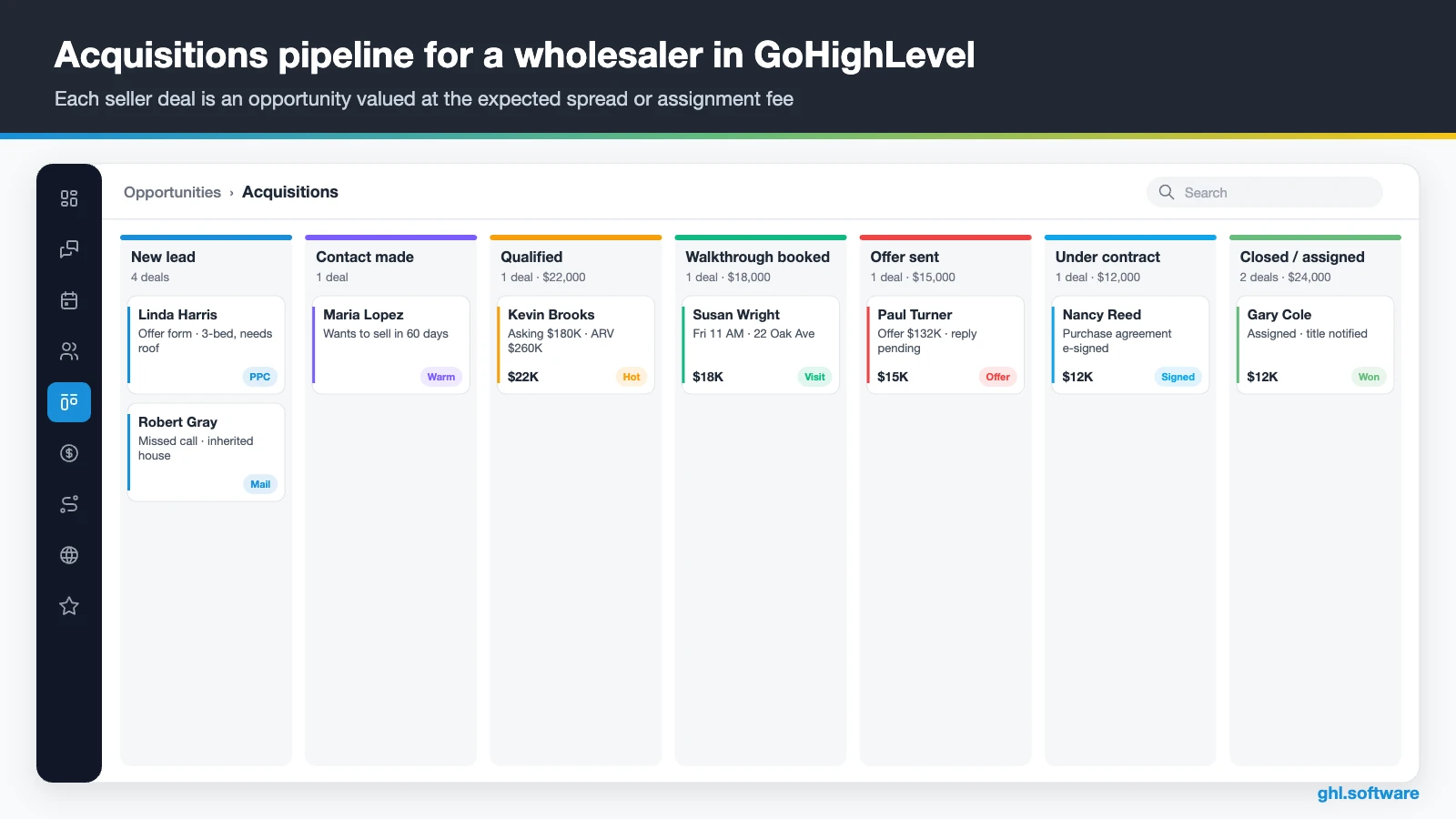
In HighLevel every deal is an opportunity with an owner, a value and a source. For investors, however, the value works best as the expected spread or assignment fee, not the purchase price. That way the Forecast tab shows expected profit and flags deals whose close dates have slipped. Run acquisitions and dispositions as two separate pipelines, because sellers and buyers move through different steps.
| Acquisitions stage | What moves the deal here |
|---|---|
| New lead | A form, PPC page, call or mail reply creates the opportunity |
| Contact made | The seller replies or the rep logs a call |
| Qualified | Motivation, condition, timeline and asking price are saved in fields |
| Walkthrough booked | The seller books on the walkthrough calendar |
| Offer sent / negotiating | The rep logs the offer amount and the next follow-up date |
| Under contract | The purchase agreement is signed through Documents & Contracts |
| Closed or follow-up later | Won when it closes; “not ready” sellers move into the long nurture |
Dispositions and rehab boards
The dispositions board starts once a deal is under contract: ready to market, sent to buyers, showing, buyer offer, assignment signed and closed. Meanwhile, a flipper can add a rehab board, and a landlord a rentals board. Each board stays simple, because the Property record ties them together.
Properties as a custom object
A house is not a contact, so HighLevel lets you create custom objects on every plan, with up to 10 objects and 300,000 records per object (HighLevel help). Also, its official real estate case study builds a “Property” object and links it to clients, vendors and deals. For example, 18 Pine St can link to Linda as the seller, three interested buyers and the title company. Still, it is a record you maintain, not a data feed: comps and owner data come from your data tool.
Three automations for wholesalers and flippers
These three workflows turn a real estate investor CRM into a system that works at night. They cover the first minute, the long middle and the sale to a buyer.
Seller speed to lead with a call queue
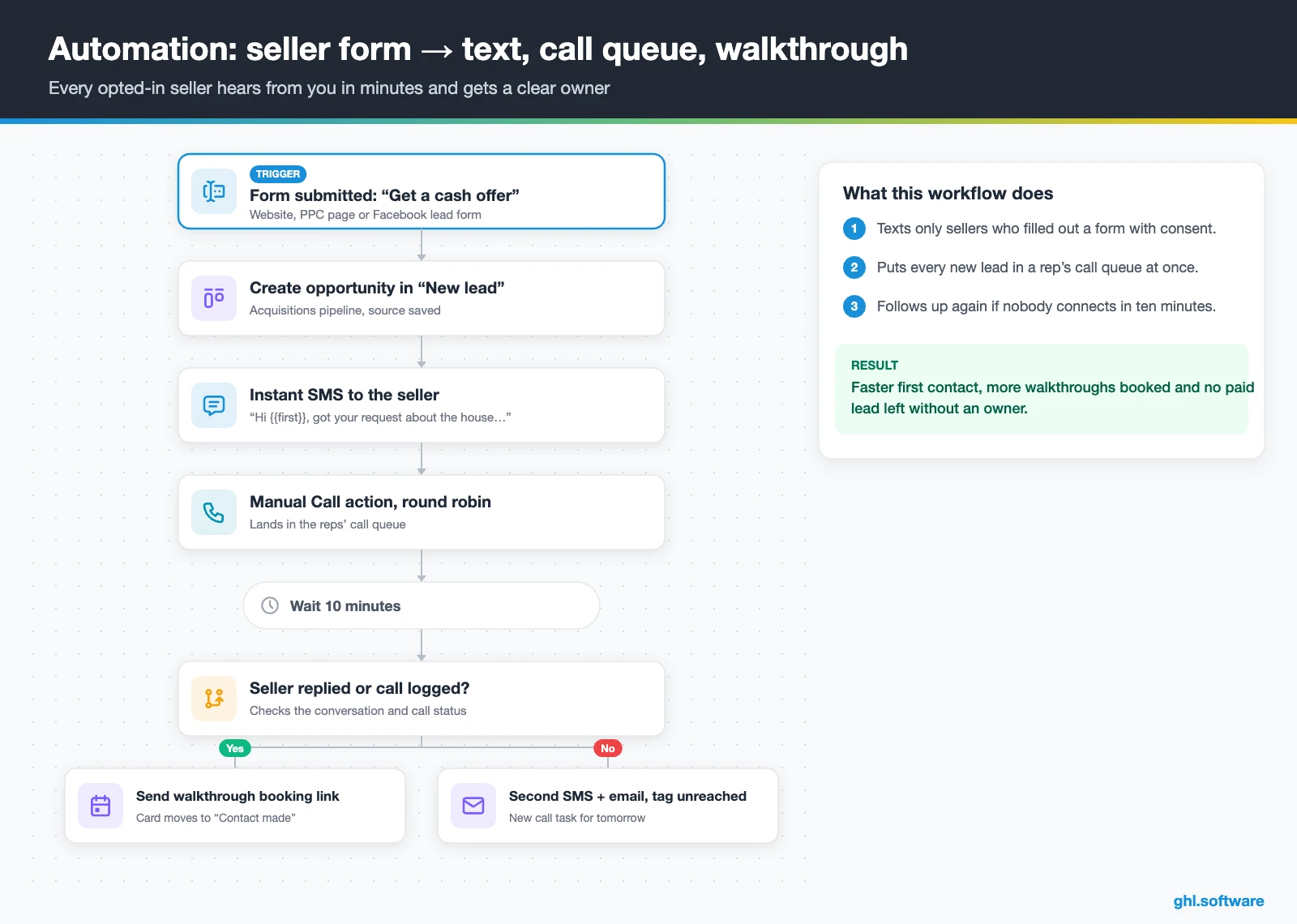
The trigger is a seller form submitted on your site, a PPC page or a Facebook lead form. Then the workflow creates the opportunity in “New lead”, texts the seller a short question about the property and adds a Manual Call action. That action then puts the contact in the reps’ queue under Conversations › Manual Actions, with round-robin assignment (HighLevel help).
After ten minutes, an if/else checks for a reply or a logged call. If the seller answered, the workflow then sends the walkthrough booking link and moves the card. Otherwise it sends a second text and an email, tags the contact “unreached” and creates a new call task for the next day. As a result, every opted-in seller hears from you in minutes, and every lead has a clear owner.
The 12-month nurture for “not ready” sellers
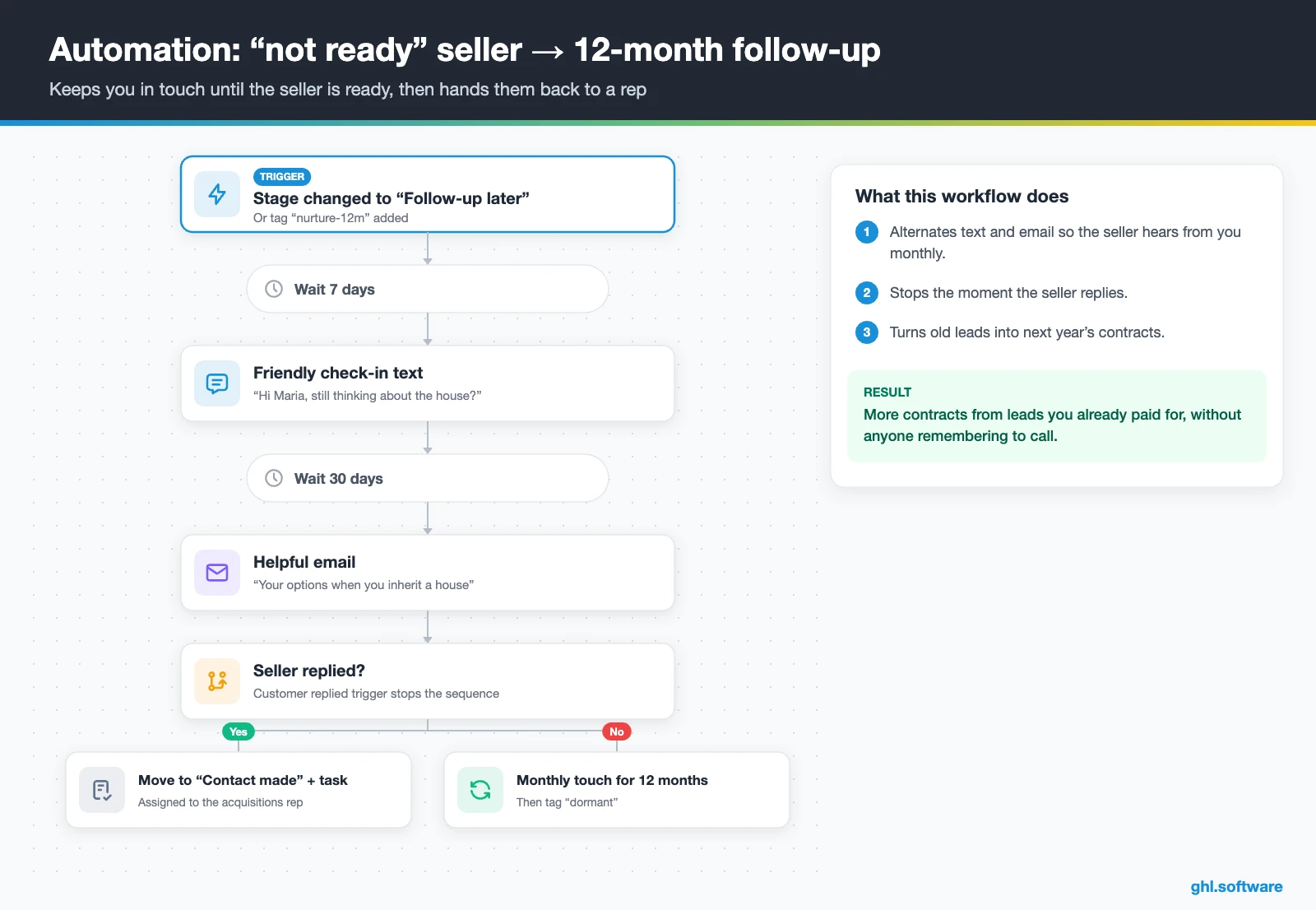
Many sellers need months, not days. So when a rep moves a card to “Follow-up later”, a second workflow takes over. First it removes the contact from active sequences, then waits seven days and sends a friendly check-in text. Thirty days later, an email shares something useful, for example the options people have when they inherit a house.
After that, a monthly touch alternates text and email for a year. If the seller replies at any point, however, the workflow stops, moves the card back to “Contact made” and creates a task for the rep. Otherwise, after twelve quiet months the contact gets a “dormant” tag. In fact, this is the workflow that turns old leads into next year’s contracts.
Deal blast to your buyers list
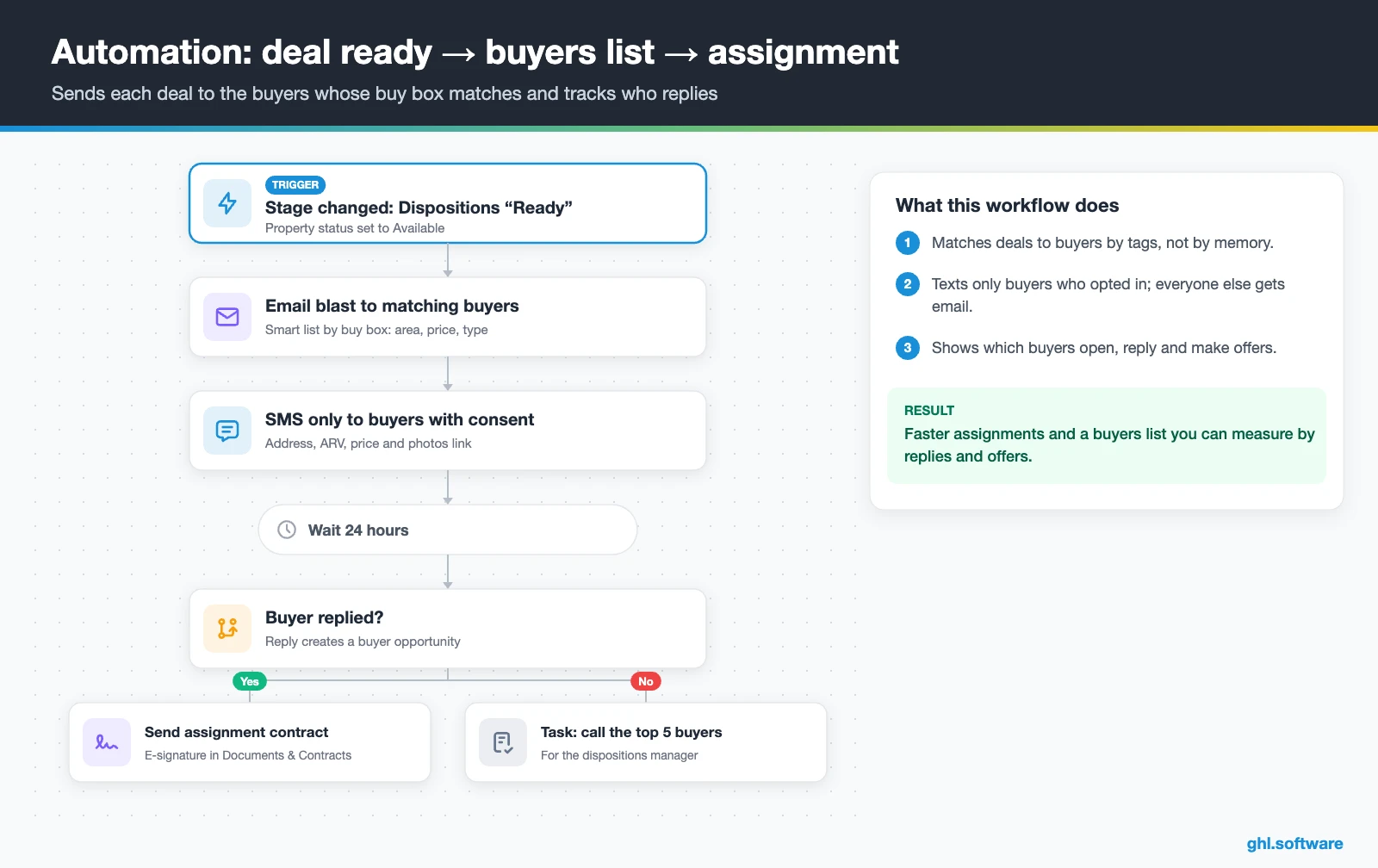
The third workflow starts when a deal moves to “Ready to market” on the dispositions board. It then pulls the address, ARV, price and photo link from custom values and emails every buyer whose buy-box tags match the area and price. Buyers who gave SMS consent also get a short text, while the rest only receive email.
When a buyer replies, the workflow creates a buyer opportunity and sends the showing calendar. After you pick a buyer, the assignment contract goes out for e-signature, and the signed status moves the card and notifies your title contact. Meanwhile, opens, replies and offers show you which buyers are active.
Start with the snapshot and the pipeline from this guide, then add the automations one by one. The extended trial comes with our bootcamp link.
Start the 30-day trialAffiliate link. I may earn a commission at no extra cost to you.
Calls, texts and AI for seller conversations
Investors talk to sellers mostly by phone. So in a real estate investor CRM, the phone system matters a lot. The web dialer also handles calls, transfers and voicemail from the browser or the mobile app, and texts, emails, DMs and chat share the same inbox.
Beyond the phone, AI covers the hours when nobody answers. Voice AI agents can answer inbound calls, ask qualifying questions and book a walkthrough (HighLevel help). Meanwhile, Conversation AI does the same in texts and chat. HighLevel’s “Riley” real estate outbound agent is still listed as coming soon, so don’t plan around it. AI is billed per use or as a monthly add-on, as our AI Employee pricing guide explains.
Is there an official HighLevel snapshot for investors?
No. HighLevel’s playbook library has no investor or wholesaling snapshot. Instead, the closest official kit is the Real Estate Agent playbook, a generic template. You can load it as a starting point; still, expect to rebuild most of it. Out of the box it gives you:
- A “Real Estate Agent” website and a “Real Estate Agent Offer” funnel: an opt-in step, then a booking page.
- The “Marketing Form – Claim Offer” form and a generic “Marketing Pipeline”.
- The “New Lead Nurture (Fast 5)” and “Long Term Nurture” workflows, with email, SMS and a voicemail drop.
- Service calendars, custom values, a chat widget, snippets and a Voice AI prompt.
What you still build yourself is the real estate investor CRM logic: acquisitions and dispositions pipelines, the Property object, the buyer sign-up form with buy-box questions and the call queue. You also write the nurture and the deal blast. Finally, if you run several markets or serve investor clients as an agency, save the finished build as your own snapshot.
How to set up HighLevel as a real estate investor CRM
Follow this order, so that consent, routing and reporting work from the first lead.
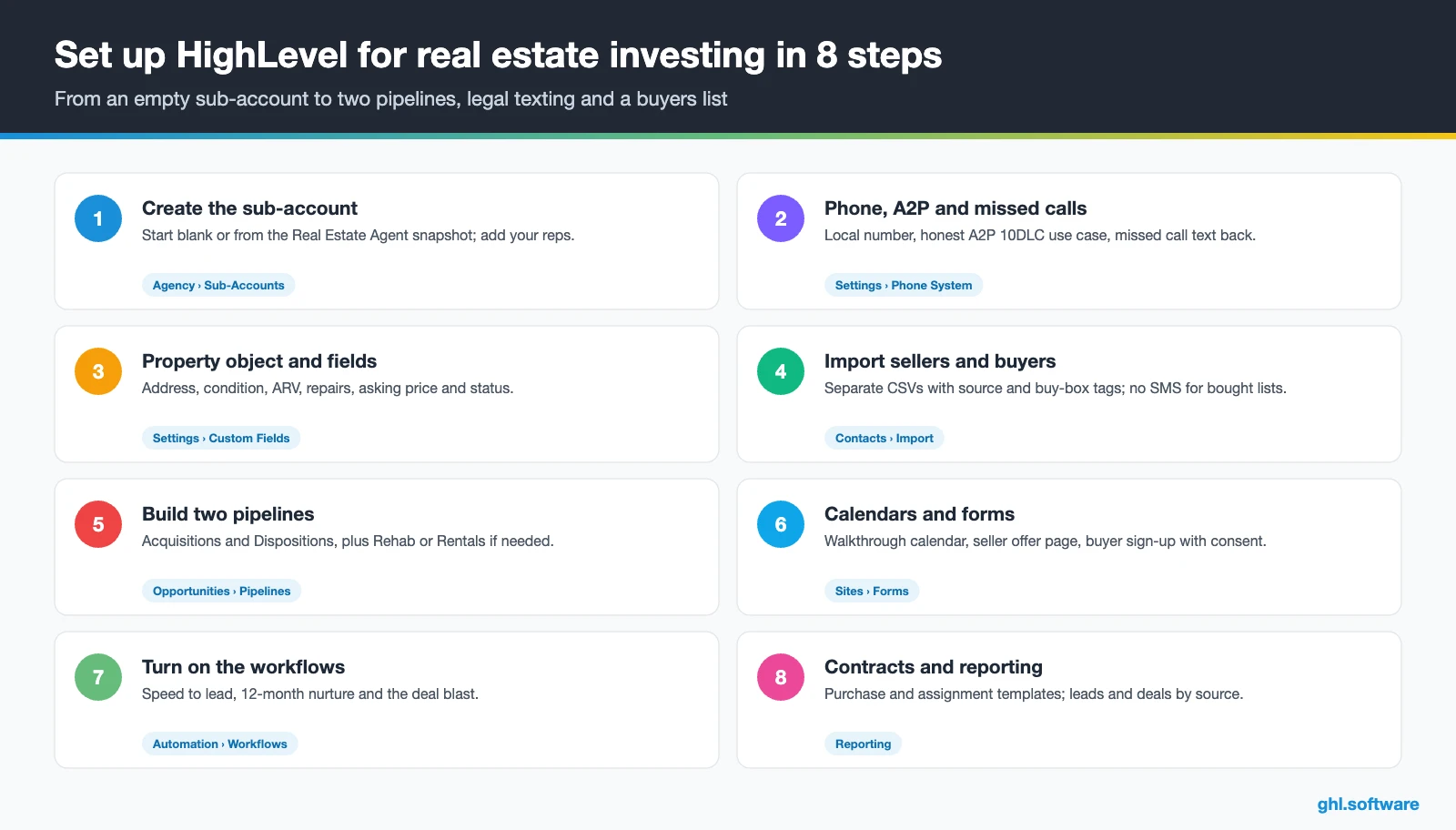
- Create the sub-account. Start blank or from the Real Estate Agent snapshot, then add one user per rep.
- Connect phones and A2P. Buy a local number, register A2P 10DLC with an honest use case and then turn on missed call text back.
- Create the Property object. Add address, condition, ARV, repairs, asking price and status, then link it to contacts and deals.
- Import sellers and buyers. Upload separate CSVs with source and buy-box tags. However, never put purchased lists in SMS workflows.
- Build the pipelines. Create Acquisitions and Dispositions, and also Rehab or Rentals if needed.
- Set up calendars and forms. Add a walkthrough calendar, then publish a seller offer page and a buyer sign-up form with an SMS consent box.
- Turn on the workflows. Activate the three automations and also a Voice AI agent for inbound calls.
- Add contracts and reporting. Finally, upload your contract templates, build a dashboard by source and connect other tools through webhooks.
What a real estate investor CRM costs on HighLevel
HighLevel charges a flat plan price with unlimited users and contacts, so adding a second acquisitions rep costs nothing extra. Usage, however, is billed on top: numbers, texts, minutes, email, WhatsApp and AI.
For example, take a two-person wholesaling team on Starter ($97) with two local numbers ($2.30) and 3,000 SMS segments (about $22 plus carrier fees). Add 2,000 outbound minutes (about $33), 1,000 inbound minutes (about $12) and 10,000 emails (under $7). As a result, that team lands near $175 a month, or about $270 with the $97 AI plan. You also pay the A2P fees and your data tool. For comparison, REsimpli lists its Solo plan at $249 a month on its own site, with data features included. The full breakdown is in our pricing guide.
GoHighLevel plans compared
| Starter | Unlimited | Founder (formerly Agency Pro) | |
|---|---|---|---|
| Price | $97/month | $297/month | $497/month |
| Annual | $970/year | $2,970/year | $4,970/year |
| Sub-accounts | 3 | Unlimited | Unlimited |
| Contacts and users | Unlimited | Unlimited | Unlimited |
| All core features | Yes | Yes | Yes |
| White label web app | Yes | Yes | Yes |
| API access | Basic | Basic | Advanced, agency-level keys |
| Rebill phone and email | No | At cost | With markup |
| Rebill AI usage | No | No | Yes |
| SaaS Mode and automated sub-accounts | No | No | Yes |
| User and agent reporting | No | No | Yes |
| Support | 24/7 | 24/7 | 24/7 |
Usage costs on top of the plan
| Item | Official price | When you pay it |
|---|---|---|
| Local phone number (US/Canada) | $1.15/month | Each number for SMS and calls |
| SMS (US/Canada) | $0.00747 per segment + carrier fees | Every text sent or received |
| Calls (US) | $0.0166/min outbound, $0.01165/min inbound | Calls through LC Phone |
| A2P 10DLC registration | $22.50 one-time (low volume) + monthly campaign fee | Before texting US numbers |
| Email (LC Email) | $0.675 per 1,000 emails | Campaigns and workflow emails |
| $10/month per sub-account + Meta fees | If you use WhatsApp inside HighLevel | |
| AI | Pay-per-use, or $50 or $97/month per sub-account | Voice AI, Conversation AI and other AI tools |
| Premium workflow steps | $0.01 per run after 100 free | Webhooks, Google Sheets, Slack, app actions |
Real estate investor CRM limits and alternatives
As a real estate investor CRM, HighLevel is strong at follow-up and marketing, but it is not a data platform. So check these gaps first.
- No skip tracing, list stacking or property data. There are no comps or owner lookups, so pair it with PropStream, DealMachine or BatchLeads and import CSV files.
- No direct-mail fulfillment. Postalytics can send mail from a workflow webhook (Postalytics guide), and thanks.io also lists a HighLevel integration.
- No documented parallel dialer. The dialer and Manual Call queue work one call at a time, so high-volume cold-calling teams often keep a separate dialer.
- No property accounting. Instead, rehab budgets, rent ledgers and books stay in QuickBooks or your property management software.
- No LP investor portal. So syndicators need a dedicated portal for distributions and tax documents.
HighLevel vs REsimpli, Podio and DealMachine
Here is how HighLevel compares with the real estate investor CRM tools people often shortlist. Features change often, so confirm details on each vendor’s site.
| GoHighLevel | REsimpli | Podio | DealMachine | |
|---|---|---|---|---|
| Built only for real estate investors | No | Yes | No | Yes |
| Skip tracing and property data included | No | Yes | No | Yes |
| White label for agencies | Yes | No | No | No |
| Price (as listed, Oct 2026) | $97/mo, unlimited users | From $249/mo (Solo) | See vendor | See vendor |
| Best fit | Fast follow-up, funnels, AI and messaging at a flat price, plus a data tool | Data, marketing and CRM from one investor vendor | Teams that want to build their own workspace from apps | Finding properties and owners, including driving for dollars |
Many investors combine tools: a data app finds properties, a mail house sends postcards, and HighLevel then handles every conversation.
Texting and calling rules for investors: consent, A2P, DNC and state laws
Wholesaling itself is regulated in some states. For example, Pennsylvania’s Act 52, signed in July 2024, treats wholesalers like brokers for licensing. It also requires clear disclosures and gives sellers a cancellation right (Barley Snyder). Other states have their own rules, so ask a local attorney to review your contracts before you load them into HighLevel.
The step most guides skip: turning cold outreach into opted-in leads
Reviews of a real estate investor CRM usually stop at “HighLevel has no skip tracing”. Instead, the more useful question is where each tool belongs. In short, your data tool builds the list, while mail or DNC-scrubbed manual calls start the conversation. HighLevel then takes over the moment a seller raises a hand.
For example, every postcard carries a short URL or QR code to a HighLevel offer page with a consent checkbox, plus a call tracking number for that campaign. When the seller fills out the form or calls, the workflows from this guide start on a contact who asked to hear from you. As a result, your texts stay within carrier rules, and reporting shows the cost per deal for each mail drop. You can compare setups like this one in our industry guides, or browse every module in the features hub.
Open a free account, load the pipeline and turn on the first automation today. The bootcamp walks you through the setup live.
Start the 30-day trialAffiliate link. I may earn a commission at no extra cost to you.
Frequently asked questions
What is the best CRM for real estate investors?
It depends on what you lack. If you want property data, skip tracing and a CRM from one vendor, an investor-only tool such as REsimpli fits. If your problem is slow follow-up, scattered conversations and no nurture, HighLevel covers that with workflows, call queues, AI and funnels at a flat price. Many investors pair HighLevel with a data tool such as PropStream or DealMachine.
What features should a real estate investor CRM have?
Look for two pipelines (acquisitions and dispositions), property records linked to sellers and buyers, and instant follow-up on new leads. Add a long nurture for sellers who are not ready, a call queue, buy-box tags for your buyers list and e-signature for purchase and assignment contracts. Finally, you need reporting by lead source, so you know which campaign produces contracts.
Is GoHighLevel good for real estate wholesaling?
Yes, for the conversation side. It texts opted-in sellers in seconds, queues calls for reps, runs 12-month follow-up and blasts deals to matching buyers. It also builds seller websites and offer pages. However, it does not pull lists, skip trace or send mail, so wholesalers usually add a data tool and a direct-mail service that connects through a webhook or integration.
Does GoHighLevel have skip tracing or list stacking?
No. HighLevel’s documentation shows no native skip tracing, list stacking, comps or driving-for-dollars app. You get those from a data provider such as PropStream, DealMachine or BatchLeads and import the results as a CSV with tags. Keep in mind that a skip-traced phone number is not consent, so those contacts should not enter SMS workflows.
Can I text skip-traced or purchased lists from GoHighLevel?
No. HighLevel’s messaging policy prohibits using contact lists bought from third-party providers without direct consent and rules out purchased or shared consent for SMS. Carriers can also block your A2P campaign. Instead, use mail and DNC-scrubbed manual calls for cold outreach, and send interested sellers to a form with a consent checkbox. Then text them from HighLevel.
How much does a CRM for real estate investors cost?
On HighLevel, Starter costs $97 a month and Unlimited $297, both with unlimited users. Usage comes on top: $1.15 per number, about $0.0075 per SMS segment plus carrier fees, call minutes, email and optional AI at $50 or $97 a month. A small wholesaling team usually spends $150 to $300 a month, plus its data tool.
How do I manage a cash buyers list in HighLevel?
Build a buyer sign-up form that asks for areas, price range, property types and financing, and save each answer as a tag or custom field. Smart lists then filter buyers by buy box. When a deal is ready, a workflow emails the matching list and texts only buyers who gave SMS consent. Replies become buyer opportunities on your dispositions board.
More industry guides
Sources: HighLevel help: forbidden message categories · HighLevel help: A2P 10DLC campaign approval best practices · HighLevel help: Custom Objects real estate case study · HighLevel help: Custom Objects in all plans · HighLevel help: Manual Call action · HighLevel Real Estate Agent playbook · FTC: scrub call lists every 31 days · MoFo: Eleventh Circuit vacates FCC one-to-one consent rule · Barley Snyder: Pennsylvania Act 52 on wholesaling · Postalytics: trigger direct mail from GoHighLevel