

CRM for Financial Advisors: Prospecting and Nurture in HighLevel
A CRM for financial advisors has two jobs: keeping the book of record, and winning and keeping clients. GoHighLevel does the second job well, with webinar follow-up, discovery-call booking, proposals with e-signature, annual review reminders and referral asks. However, it has no custodian integrations and no native compliance archiving, so it sits next to Wealthbox or Redtail and a message archiver.
Robert Hayes spent Tuesday evening at your retirement income seminar at the public library. He stayed after to ask about rolling over his 401(k), took your card and drove home. Then nothing happened. However, your assistant was buried in paperwork, and you meant to call on Thursday. Two weeks later, Robert signed with the advisor whose office texted him the next morning. A CRM for financial advisors should catch that moment, not just store his household data afterwards.
Most advisor CRMs are built around the client you already have: households, accounts, service tasks and notes. They do that job well. However, the work before the first meeting often lives in spreadsheets and good intentions. So do the reminders that keep reviews and referrals on schedule.
So this guide shows how GoHighLevel (HighLevel) fills that front end for an independent advisor or a small RIA. You will see the prospect pipeline, three automations, texting and recordkeeping rules, the official snapshot, setup, costs and honest limits. For other professions, browse the industry guides.
Leer en español: CRM para asesores financieros · Ler em português: CRM para assessores financeiros · Part of GoHighLevel by industry
What a financial advisor needs from a CRM
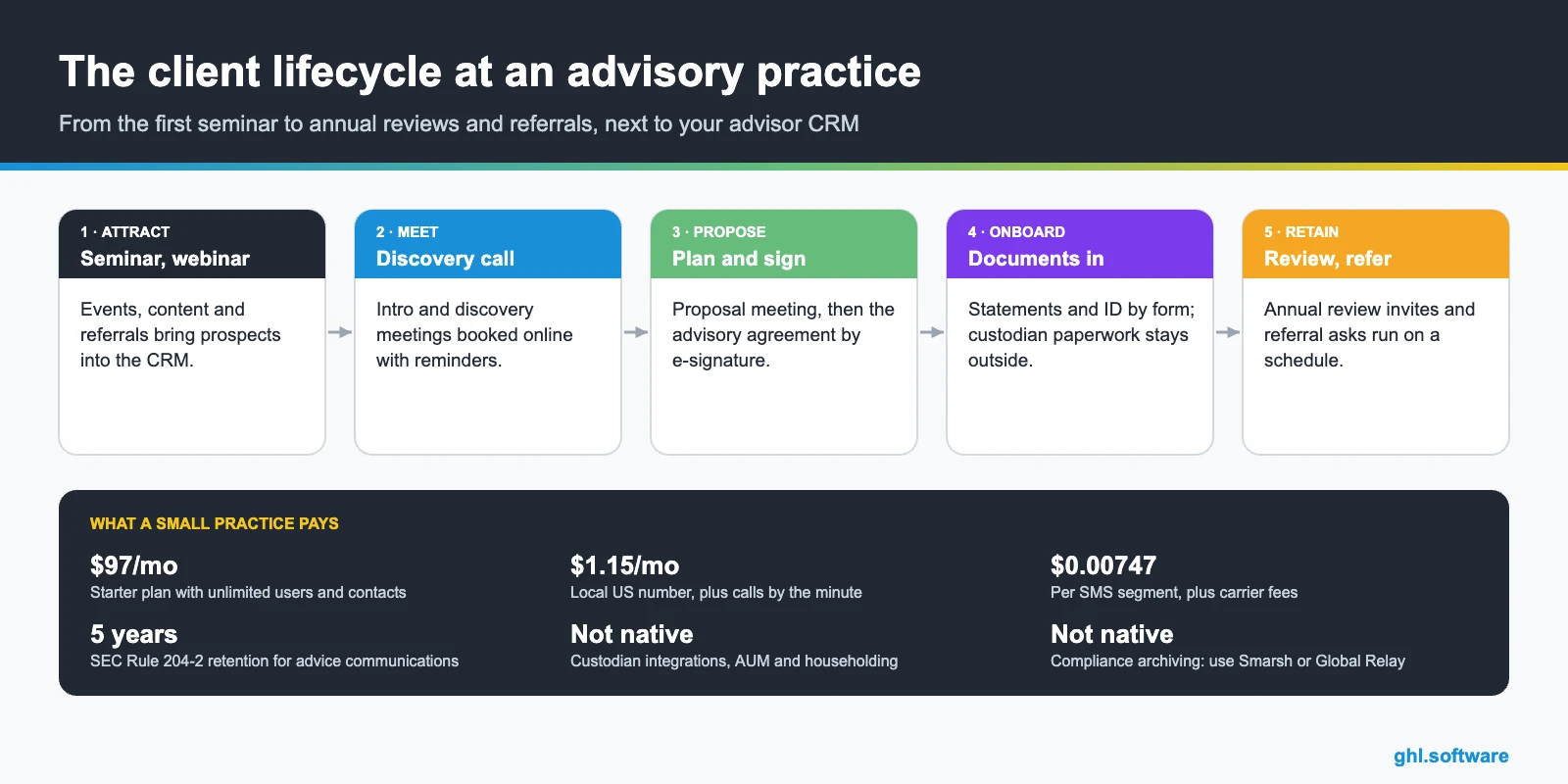
Advisors sell trust over a long cycle. For example, a prospect may attend a webinar in March, book a call in May and transfer assets in August. Meanwhile, you need fast follow-up, reminders, document collection and a clean handoff to operations. Therefore, a CRM for financial advisors has to handle marketing and scheduling, not only records.
Advisor pain points and how HighLevel solves them
Most practices lose prospects and goodwill in the same few places, and a CRM for financial advisors should close each gap. The table maps each one to what HighLevel does and the feature behind it.
| Pain | What HighLevel does | Feature |
|---|---|---|
| Seminar leads go cold | Sends a thank-you, a replay and a booking link the same evening | Events, workflows |
| Discovery-call no-shows | Sends email and SMS reminders, then a rebook link | Calendars, workflows |
| Chasing statements and IDs | Sends a document request form and reminds until it is complete | Forms, workflows |
| Proposals waiting for signatures | Sends the agreement for e-signature and reminds until it is signed | Documents & Contracts |
| Annual reviews slip | Starts the invite 30 days before each client’s review date | Custom date reminder |
| Referral asks never happen | Asks for an introduction after a positive post-review survey | Surveys, if/else |
| Campaigns waiting on compliance | Holds any broadcast until a “compliance approved” tag is added | Tags, if/else |
| Leads scattered across inboxes | Keeps SMS, email and social messages in one thread per contact | Conversations |
The prospect pipeline in a CRM for financial advisors
A prospect pipeline should follow your real process, from first touch to assets in motion. Each stage needs a clear trigger. For example, a booked intro call moves the card automatically, while “Plan presented” stays a manual move by the advisor. Meanwhile, a second pipeline called “Client service” handles reviews for existing clients.
Keep the pipeline about relationships, not account data. After all, balances, positions and households belong in your advisor CRM and custodian platform. That way, HighLevel stays light and your book of record stays in one place.
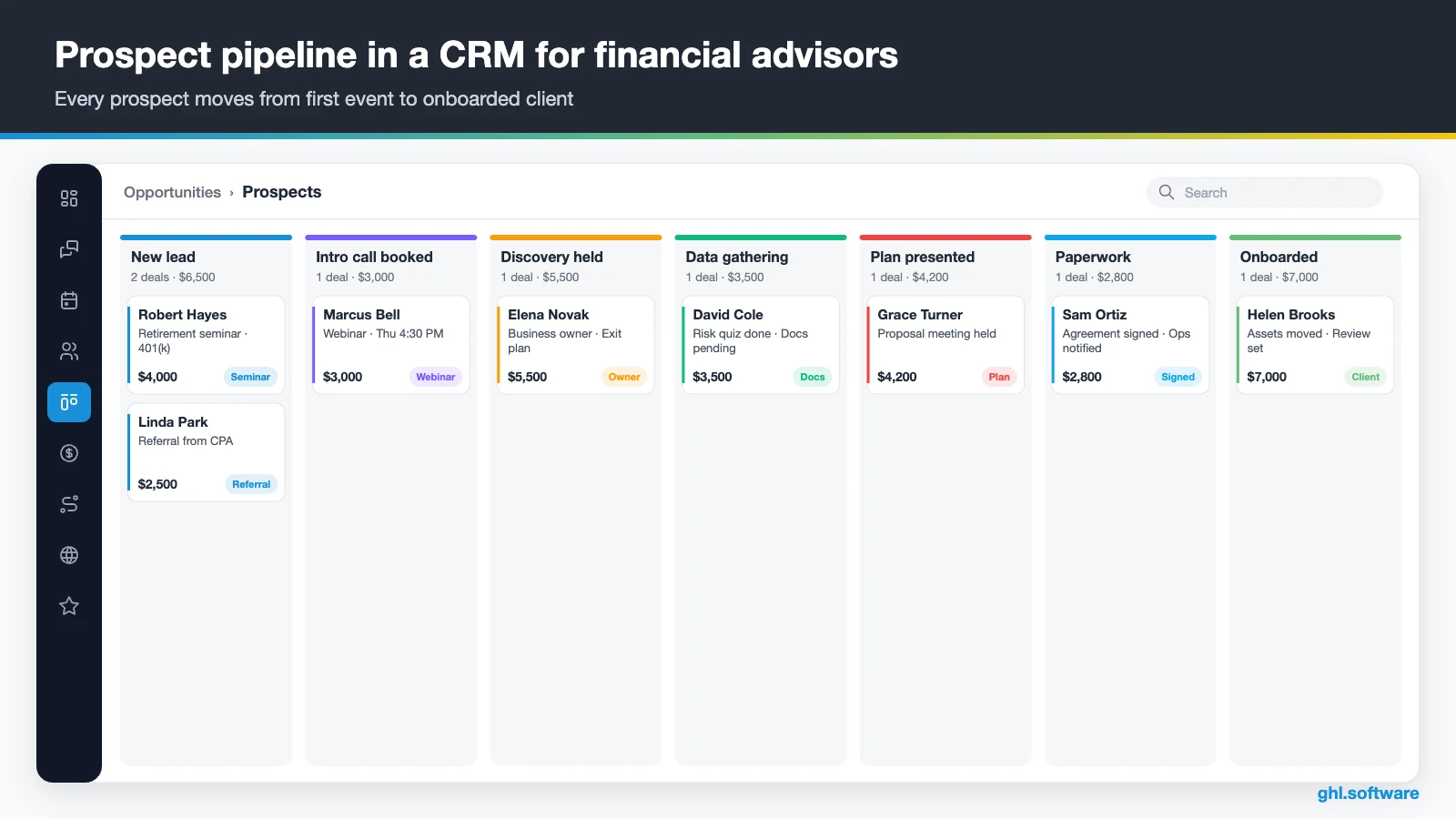
| Stage | What moves the prospect here |
|---|---|
| New lead | Webinar or seminar registration, referral, website or LinkedIn form |
| Intro call booked | The prospect books a 15-minute call on the advisor calendar |
| Discovery held | The appointment is marked “showed” and the advisor logs notes |
| Data gathering | The risk questionnaire and statement upload form are sent |
| Plan presented | The advisor presents the proposal in a second meeting |
| Paperwork | The advisory agreement is signed; operations prepares custodian forms |
| Onboarded | Assets have moved; the client joins the Client service pipeline |
Three automations for prospecting and client service
A CRM for financial advisors doesn’t need dozens of workflows. Instead, these three are enough: event follow-up, proposal to paperwork, and the annual review. To get familiar with the builder first, HighLevel’s own video “The New Advanced Workflow Builder In HighLevel” tours it. Watch for triggers, waits and if/else branches.
Video: The New Advanced Workflow Builder In HighLevel · HighLevel
Webinar registration → intro call booked
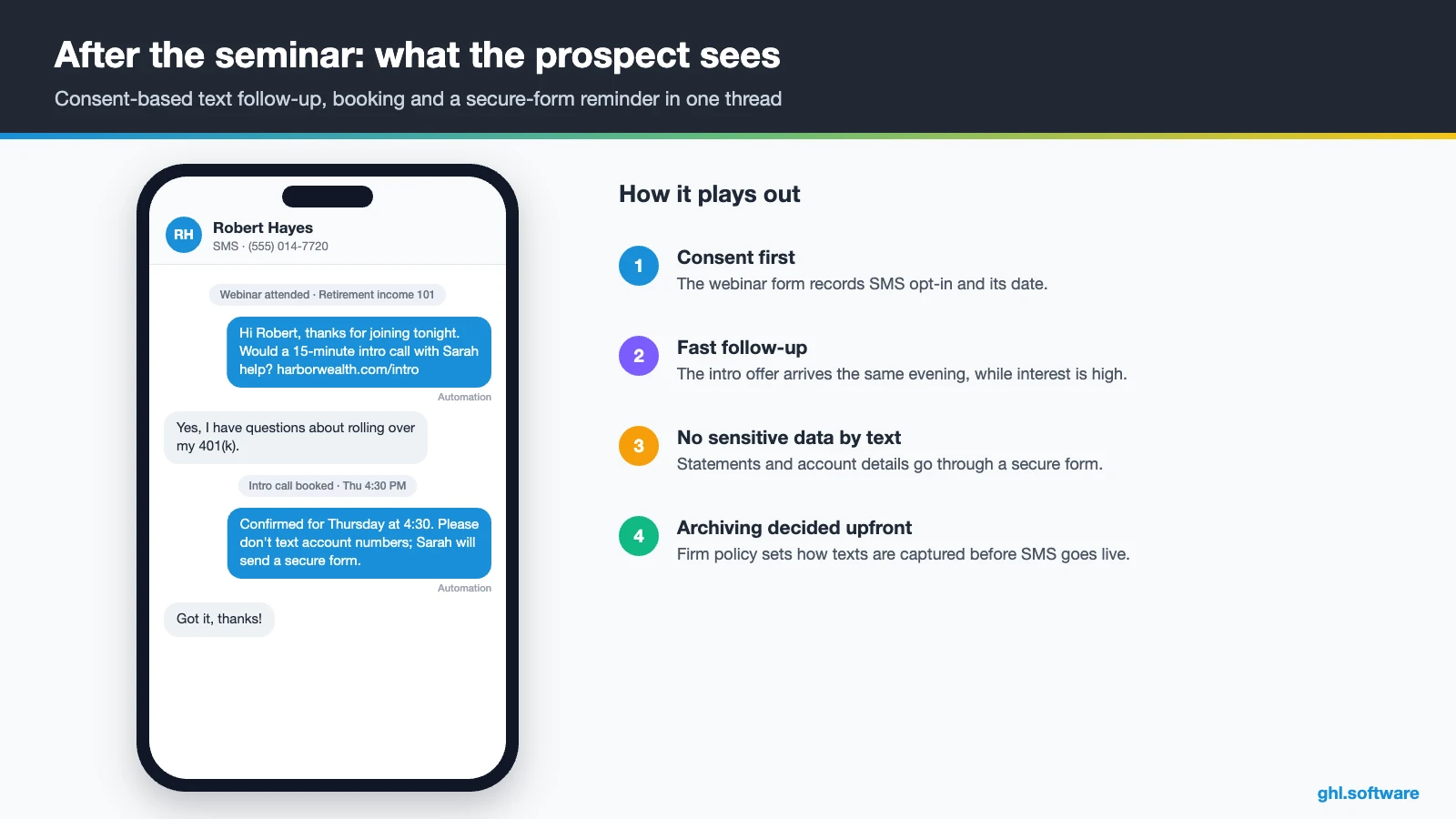
The trigger is the webinar registration form. HighLevel sends a confirmation email with a calendar link right away, plus a text if the person opted in to SMS. Reminders follow 24 hours and one hour before the start. Then, after the event, a tag from your webinar tool or a webhook tells the workflow who attended.
Attendees get a short text offering a 15-minute intro call, while no-shows get the replay by email. If nobody books within two days, the advisor gets a call task. Once the prospect books, the card moves to “Intro call booked”. As a result, the energy from the event turns into meetings instead of fading.

Plan presented → signed agreement → documents in
When the advisor moves the card to “Plan presented”, the workflow sends the advisory agreement from a Documents & Contracts template. HighLevel documents support several signers, a signing order and an audit certificate with IP addresses and timestamps. After 48 hours without a signature, the prospect receives a polite reminder.
Once the agreement is signed, the workflow sends a document request form for statements and ID. Three days later, it checks for a “documents complete” tag. If the tag is missing, the client gets a reminder and the assistant gets a task. Finally, operations receives an internal notification to start the custodian paperwork, which happens outside HighLevel.

Annual review → referral ask
The trigger is a custom date field, “Next review date”, firing 30 days ahead. So the client receives an email invite with a booking link. If they haven’t booked after a week, a text follows, and after another week the assistant gets a call task. After the review is marked “showed”, a short survey goes out the next day.
Clients who score 9 or 10 receive a referral request with a simple form for introducing a friend. However, lower scores create a task for the advisor to follow up personally. Then the workflow moves “Next review date” forward twelve months. In short, reviews stay on schedule and referral asks happen every time, not only when you remember.

Start with the snapshot and the pipeline from this guide, then add the automations one by one. The extended trial comes with our bootcamp link.
Start the 30-day trialAffiliate link. I may earn a commission at no extra cost to you.
Texting, email and AI for advisors, with recordkeeping in mind
Clients like texts for scheduling, so SMS is tempting. However, texting is also where advisors get into recordkeeping trouble. Registered investment advisers must keep written communications about recommendations or advice for five years, under SEC Rule 204-2. Broker-dealers keep business communications for at least three years under Rule 17a-4. FINRA also expects firms to allow only electronic channels they can record and retain.
HighLevel stores conversations in its inbox, but it is not a compliance archive. A third-party HighLevel partner notes that it does not feed archivers like Smarsh or Global Relay natively. Therefore, decide your texting policy with compliance before you register A2P 10DLC. Either capture texts in your approved archive, or limit SMS to logistics such as confirmations and reminders, if your policy allows that.
AI follows the same logic. Conversation AI can answer website chat questions about office hours, services and booking, and Voice AI can schedule intro calls. Still, neither should discuss investments, returns or suitability. Hand those conversations to a licensed person, and keep the AI script reviewed by compliance.
What HighLevel’s official Financial Planner snapshot includes
HighLevel publishes a Financial Planner playbook with a matching snapshot. Still, it follows the generic template HighLevel uses for every industry, with the names changed. Out of the box, you get:
- A “Financial Planner” website with a Home page, services and FAQ sections, plus a Link in Bio page.
- The “Financial Planner Offer” funnel, which goes from an opt-in to a booking page.
- The “Marketing Form – Claim Offer”, a “Marketing Pipeline” and service calendars tagged “Financial Planner Services”.
- The “New Lead Nurture (Fast 5)” workflow (email, SMS and a voicemail drop) and a “Long Term Nurture” workflow.
- Custom values, a chat widget, snippets and missed call text back as a quick win.
- A “Financial Planner” proposal template in Documents & Contracts and one “Financial Planner” ad in Ad Manager.
Still, the snapshot is a marketing starter, not a finished CRM for financial advisors. For example, it has no Voice AI prompt and no discovery-call, review-meeting or compliance workflows. So you still build the prospect and client-service pipelines, the questionnaire, your advisory agreement and the three automations above. Also, run every page, email and ad through compliance before you publish, because the template copy was not written for regulated advice.
How to set up GoHighLevel as a CRM for financial advisors
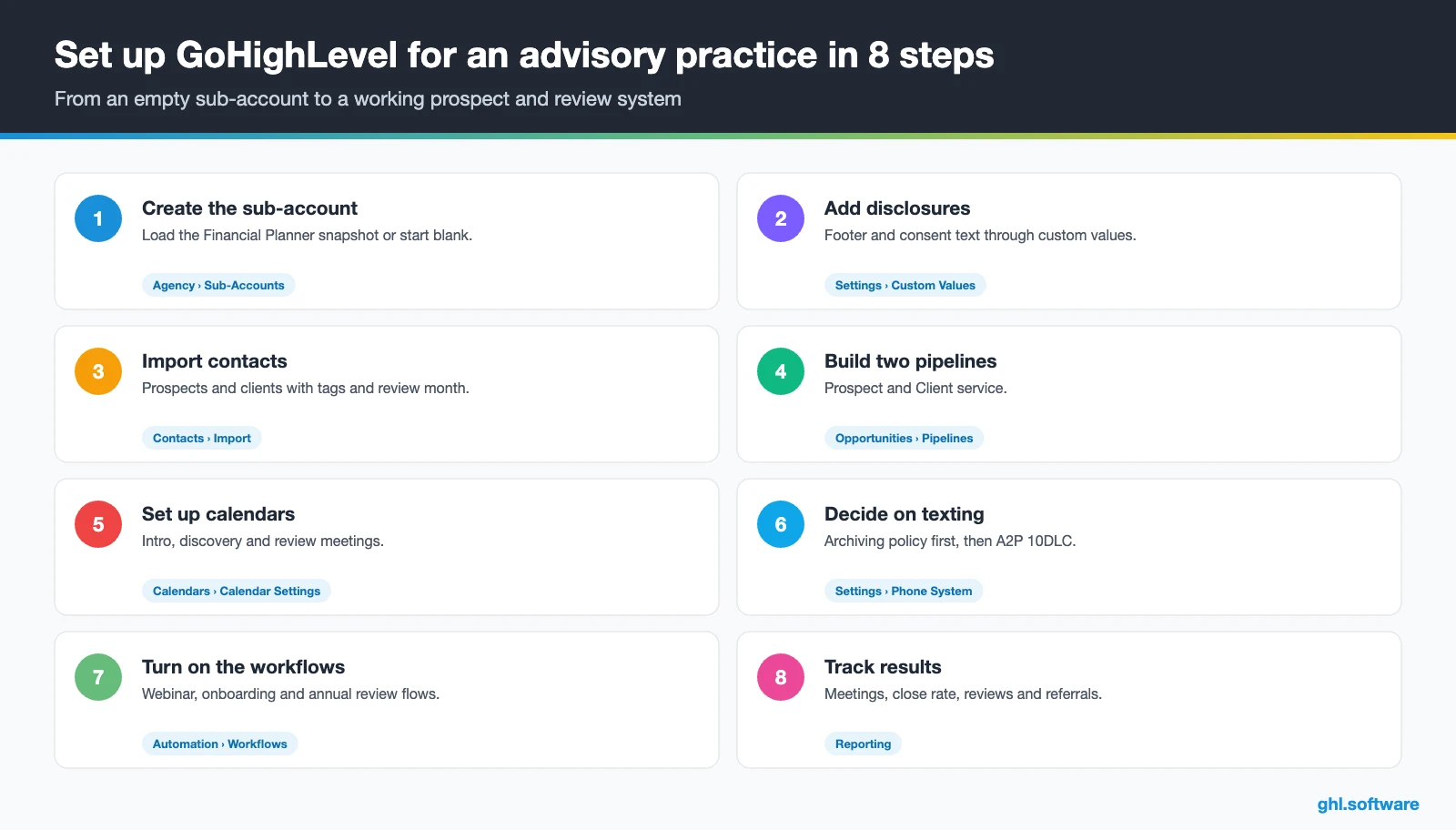
- Create the sub-account. Load the Financial Planner snapshot or start blank. Then add your branding, time zone and the disclosures that belong in email footers and form consent text.
- Import contacts. Bring prospects and clients from Wealthbox, Redtail or a CSV with tags such as prospect, client, review month and service tier.
- Build two pipelines. Create “Prospect” with the seven stages above and “Client service” with review due, booked, held and follow-up.
- Set up calendars. Add a 15-minute intro, a 60-minute discovery and a review meeting, with buffers and reminders.
- Decide on texting. Agree on a texting and archiving policy with compliance, then register A2P 10DLC in the phone system.
- Add forms and documents. Create the risk questionnaire, the document upload form and your advisory agreement template.
- Turn on the workflows. Build the three automations, plus an approval-tag gate before any promotional broadcast.
- Track what matters. Use reporting for lead source, meetings booked, close rate, on-time reviews and referrals.
What an advisory practice pays for HighLevel
As a CRM for financial advisors, HighLevel usually starts on Starter at $97 a month, with unlimited users. Besides, Unlimited at $297 suits agencies or groups that need many sub-accounts. On top of the plan, a local number costs about $1.15 a month. SMS costs $0.00747 per segment plus carrier fees, and LC Email costs $0.675 per 1,000 emails. Texting also needs the one-time A2P fee and a monthly campaign fee.
For example, picture a two-advisor office with 1,000 SMS segments, 500 call minutes and 10,000 emails a month. Its usage would add roughly $25–35, so HighLevel lands around $125 a month, or about $225 with the $97 AI plan. Finally, remember that your advisor CRM and an archiving tool are separate costs. For details, see the GoHighLevel pricing guide and the AI Employee pricing page.
GoHighLevel plans compared
| Starter | Unlimited | Agency Pro | |
|---|---|---|---|
| Price | $97/month | $297/month | $497/month |
| Annual | $970/year | $2,970/year | $4,970/year |
| Sub-accounts | 3 | Unlimited | Unlimited |
| Contacts and users | Unlimited | Unlimited | Unlimited |
| All core features | Yes | Yes | Yes |
| White label web app | Yes | Yes | Yes |
| API access | Basic | Basic | Advanced, agency-level keys |
| Rebill phone and email | No | At cost | With markup |
| Rebill AI usage | No | No | Yes |
| SaaS Mode and automated sub-accounts | No | No | Yes |
| User and agent reporting | No | No | Yes |
| Support | 24/7 | 24/7 | 24/7 |
Usage costs on top of the plan
| Item | Official price | When you pay it |
|---|---|---|
| Local phone number (US/Canada) | $1.15/month | Each number for SMS and calls |
| SMS (US/Canada) | $0.00747 per segment + carrier fees | Every text sent or received |
| Calls (US) | $0.0166/min outbound, $0.01165/min inbound | Calls through LC Phone |
| A2P 10DLC registration | $22.50 one-time (low volume) + monthly campaign fee | Before texting US numbers |
| Email (LC Email) | $0.675 per 1,000 emails | Campaigns and workflow emails |
| $10/month per sub-account + Meta fees | If you use WhatsApp inside HighLevel | |
| AI | Pay-per-use, or $50 or $97/month per sub-account | Voice AI, Conversation AI and other AI tools |
| Premium workflow steps | $0.01 per run after 100 free | Webhooks, Google Sheets, Slack, app actions |
Honest limits: no custodian data and no compliance archive
HighLevel is a prospecting and marketing layer. It has no custodian or portfolio integrations with Schwab, Fidelity or Pershing, and no household or AUM data model. It also has no native WORM archiving and cannot bill AUM fees, which run through the custodian. Therefore, keep Wealthbox, Redtail or a similar advisor CRM as your book of record.
The workable stack has four parts. HighLevel handles marketing, booking, e-signature and nurture. Meanwhile, your advisor CRM holds households, accounts and service notes. An archiver captures email and texts, and the custodian holds the assets. Between HighLevel and your advisor CRM, use webhooks, the API or an integration platform. Then test the sync before you rely on it.
Tools compared
| Tool | What it is | Where it fits |
|---|---|---|
| GoHighLevel | Marketing, booking, nurture and e-signature platform | Front end: events, discovery calls, proposals, reviews and referrals |
| Wealthbox | CRM built for financial advisors | Book of record: households, tasks, notes and workflows |
| Redtail | CRM built for financial advisors | Book of record for advisor teams |
| Salesforce Financial Services Cloud | Enterprise CRM for wealth management | Larger firms with admins and custom integrations |
| Smarsh, Global Relay | Communications archiving services | Capturing and retaining email, texts and social messages |
So which CRM for financial advisors should you choose? If you only need a book of record, an advisor-native CRM may be enough. On the other hand, HighLevel makes sense when you want events, ads, a website and nurture in one place.
The angle most guides miss: a compliance gate inside your workflows
Most guides list CRMs and stop there. In practice, the risk is not the tool but the messages it sends. So build compliance into the workflows themselves. Every promotional email or text checks for a “compliance approved” tag before it goes out. Otherwise, a missing tag creates a task instead of a send.
Next, add three habits. Capture SMS consent and its date on every form. Put your disclosures in email footers through custom values, so nobody edits them by hand. Finally, send copies of outbound messages to your archive in the way your vendor and compliance approve. That way, your CRM for financial advisors speeds up follow-up without creating a books-and-records problem.
Open a free account, load the pipeline and turn on the first automation today. The bootcamp walks you through the setup live.
Start the 30-day trialAffiliate link. I may earn a commission at no extra cost to you.
Frequently asked questions
What is the best CRM for financial advisors?
It depends on the job. For the book of record, advisor-native CRMs such as Wealthbox and Redtail are built around households, accounts and service workflows. For prospecting and nurture, including webinars, booking, e-signature, texting and referrals, GoHighLevel covers more ground. Many practices use both: the advisor CRM for client records and HighLevel as the marketing front end, plus an archiving tool for compliance.
Is GoHighLevel compliant for SEC or FINRA-regulated advisors?
HighLevel is not a compliance tool, and it does not provide native WORM archiving. It can still be used inside a compliant setup. Keep your advisor CRM as the book of record, capture email and texts in an approved archiver, add disclosures to templates and gate promotional sends behind compliance approval. Your chief compliance officer should review the setup before you send anything to clients.
Can financial advisors text clients?
Many do, but only within firm policy. Texts that relate to recommendations or advice are written communications that RIAs must keep for five years under SEC Rule 204-2, and broker-dealers have their own rule. So texts must be captured and retained, or limited to logistics if your policy allows. In HighLevel, also register A2P 10DLC and record each client’s SMS consent before sending.
Does HighLevel integrate with Wealthbox, Redtail or Schwab?
We could not verify a native integration with Wealthbox or Redtail, and HighLevel has no custodian integrations with Schwab, Fidelity or Pershing. You can connect HighLevel to other systems through webhooks, its API or an integration platform, if your advisor CRM supports one. Test any sync carefully, and keep account data in the advisor CRM and custodian platform rather than in HighLevel.
How much does a CRM for financial advisors cost?
HighLevel starts at $97 a month on Starter with unlimited users, plus usage such as $1.15 a month per local number, SMS by the segment and email at $0.675 per 1,000. A small office typically pays about $125 to $225 a month, depending on AI. Advisor-native CRMs and archiving tools are priced separately, so budget for the whole stack. See our pricing guide.
How do I automate annual review scheduling?
Add a custom date field called “Next review date” to each client. Then build a workflow with a custom date reminder trigger that fires 30 days ahead. It sends an email with your booking link, follows up by text a week later and creates a call task if the client still hasn’t booked. Finally, after the review, the workflow moves the date forward twelve months.
Can advisors ask for reviews and testimonials automatically?
Be careful. Under the SEC Marketing Rule, testimonials and endorsements come with specific conditions. HighLevel can send review requests automatically, but the content and where it appears need compliance approval first. If you do ask, ask every client, not only happy ones, and route unhappy replies to the advisor. Referral requests after a strong post-review survey are a separate, private step.
More industry guides
Sources: HighLevel playbook: Financial Planner · eCFR: SEC Rule 204-2, books and records of investment advisers · FINRA: Books and records · HighLevel help: How to use Documents & Contracts · HighLevel help: Missed call text back and A2P notes · Softomate: GoHighLevel for financial advisers (archiving note) · Wealthbox: CRM for financial advisors