

CRM for Insurance Agents: HighLevel for Life, Health and P&C
A CRM for insurance agents should answer new leads in minutes, chase every quote and start renewal reviews 60 to 90 days before the date. It should also cross-sell the rest of the household. HighLevel does this with pipelines per product line, workflows, texting, Voice AI and review requests. However, it is not an agency management system, so keep your AMS for policies, commissions and carrier downloads.
It is 9:40 p.m. when Dana Price fills out the home and auto quote form on your agency’s website. Your producer emails the quote on Wednesday, and then the thread goes quiet. Nobody follows up, so two weeks later Dana binds with an agency that called her twice. Meanwhile, three of your clients renew next month and nobody has reviewed their coverage. A CRM for insurance agents exists to close exactly those two gaps: the quote that dies in silence and the renewal nobody touches.
This guide is for independent and captive agents, small agency owners and the marketing agencies that serve them. You will see a pipeline for each product line, three automations with real triggers and the official HighLevel insurance snapshots. After that come the setup order, real costs and the compliance basics for texting and Medicare.
One point first. HighLevel is a sales, follow-up and marketing layer. It is not an agency management system, so it does not track commissions or download policies from carriers. Therefore most agencies keep their AMS and the tools around it, such as EZLynx, HawkSoft or AgencyZoom, and add HighLevel for the conversations.
Leer en español: CRM para agentes de seguros · Ler em português: CRM para corretora de seguros · Part of GoHighLevel by industry
What an insurance agency needs from a CRM
An AMS is the system of record for policies. A CRM, instead, is where selling and retention happen: the first reply, the quote chase, the renewal review and the referral ask. So a good CRM for insurance agents has to move fast, track every household and remind people at the right moment. Here is how HighLevel covers each job.

Common agency problems and how HighLevel solves them
Most agencies don’t lose business on price alone. Instead, they lose it in the follow-up: the late callback, the quote nobody chased and the renewal that arrived as a surprise. The table maps each gap to the feature that closes it when HighLevel is your CRM for insurance agents.
| Problem | What HighLevel does | Feature |
|---|---|---|
| Shared leads go cold in minutes | Texts the lead and assigns a producer within seconds | Workflows + round robin |
| Missed calls after 5 p.m. | Texts the caller back, or Voice AI answers and books a call | Missed call text back, Voice AI |
| Quotes die in silence | Runs a 10-day follow-up cadence with call tasks | Pipeline stage changed trigger |
| Renewals arrive as surprises | Starts a coverage review 90 days before the renewal date | Custom date reminder |
| Single-line households | Flags auto-only clients and offers home, umbrella or life | Custom fields + smart lists |
| No-shows on review calls | Sends reminders 24 hours and 1 hour before | Calendars |
| Owner can’t see who follows up | Shows quotes, appointments and bound policies by producer | Reporting |
Pipelines in a CRM for insurance agents, by product line
Each product line sells differently, so one pipeline for everything gets messy fast. Therefore the cleanest setup in a CRM for insurance agents is one pipeline per line, with the annual premium as the opportunity value. Reports then show premium by line and producer.
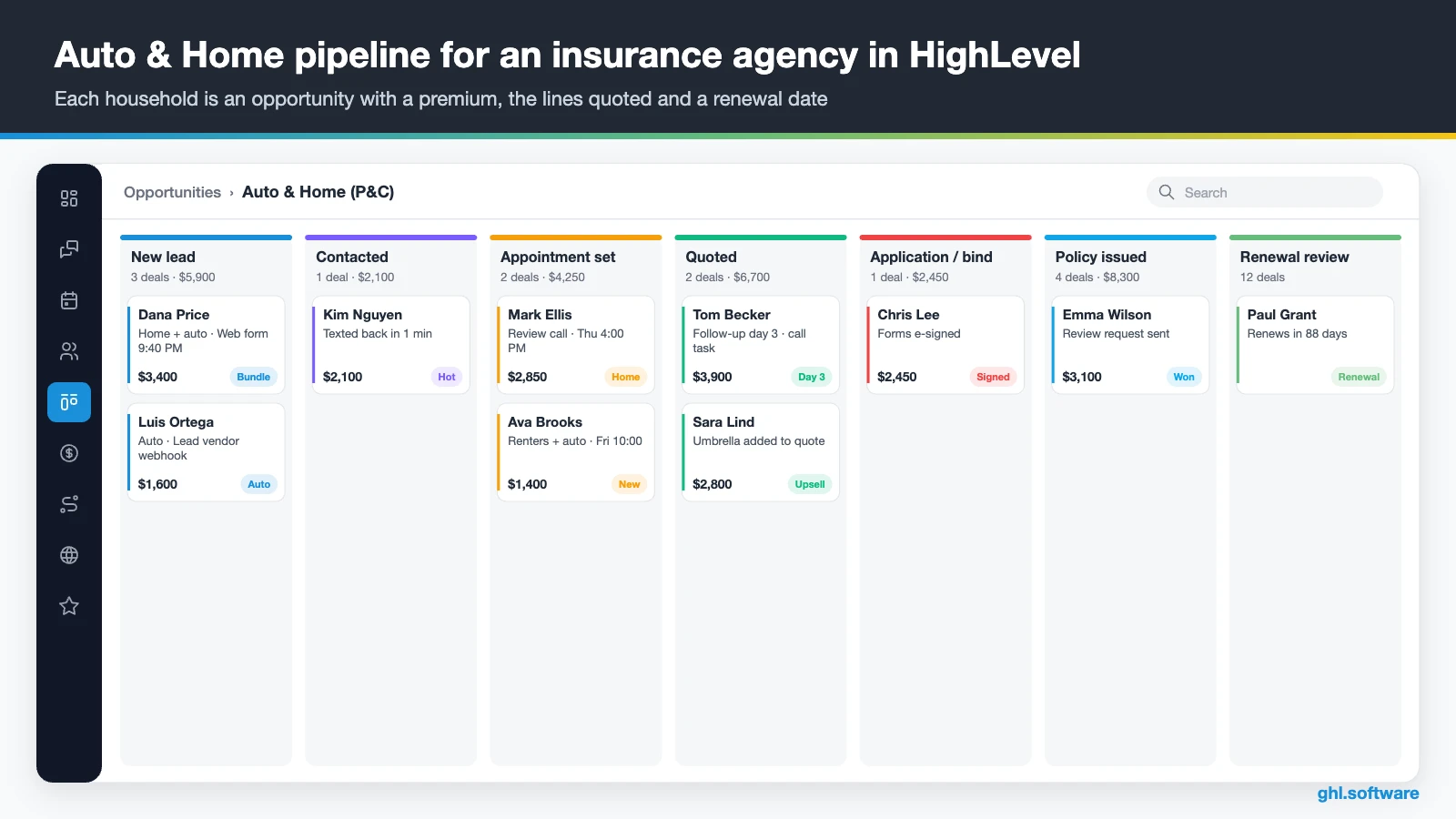
Below is the Auto & Home board for personal lines, which most P&C agencies build first. Each card carries the household, the lines quoted and the premium. Moreover, a “lines held” field on the contact records what the household already owns, which later drives cross-sell.
| Stage | What moves the card here |
|---|---|
| New lead | A quote form, lead-vendor webhook, ad lead, call or chat creates the opportunity |
| Contacted | The producer reaches the lead by phone or text, which ends the speed-to-lead cadence |
| Appointment set | The lead books a quote or review call on a producer’s calendar |
| Quoted | The producer sends the quote and moves the card, which starts quote follow-up |
| Application / bind | The client accepts and signs the application or agency forms online |
| Policy issued (Won) | The carrier issues the policy, and the renewal date and premium go into custom fields |
| Renewal review | A date-based workflow moves the household here 90 days before renewal |
How the other product lines differ
- Life and final expense: add “Application submitted” and “Underwriting” stages, because cases can wait weeks on exams and records.
- Health and Medicare: add a “Scope of appointment recorded” stage before the appointment, and keep notes minimal unless the HIPAA add-on is on.
- Commercial: add “Information gathered” and “Submitted to markets”, since one account can involve several carriers and a longer cycle.
This walkthrough from CRM Tutorials Library covers pipelines, forms and funnels for insurance agents, as its title says.
Video: How Insurance Agents Can Use GoHighLevel CRM (Pipelines, Forms & Funnels) [2026] · CRM Tutorials Library
Three automations every insurance agency should run
These workflows cover the three moments where agencies lose the most: the first five minutes, the days after a quote and the months before a renewal. Build them once in your CRM for insurance agents, then copy them to every product line.
Speed to lead with a consent check
The trigger is a new lead from a quote form, a Facebook lead form or a lead vendor’s inbound webhook. The workflow maps the source and the consent fields, such as the consent certificate URL and its timestamp. If those fields are empty, it skips automated texts and only creates a task for a producer.
If consent is on file, the lead gets a text from the agency at once, and round robin assigns the next producer. Two minutes later, that producer gets a call task, and a short cadence of texts and emails follows over seven days. As soon as the lead replies or books, the workflow stops and moves the card to “Appointment set”. As a result, shared leads hear from you first, while consent stays documented.

Quote follow-up that doesn’t give up on day two
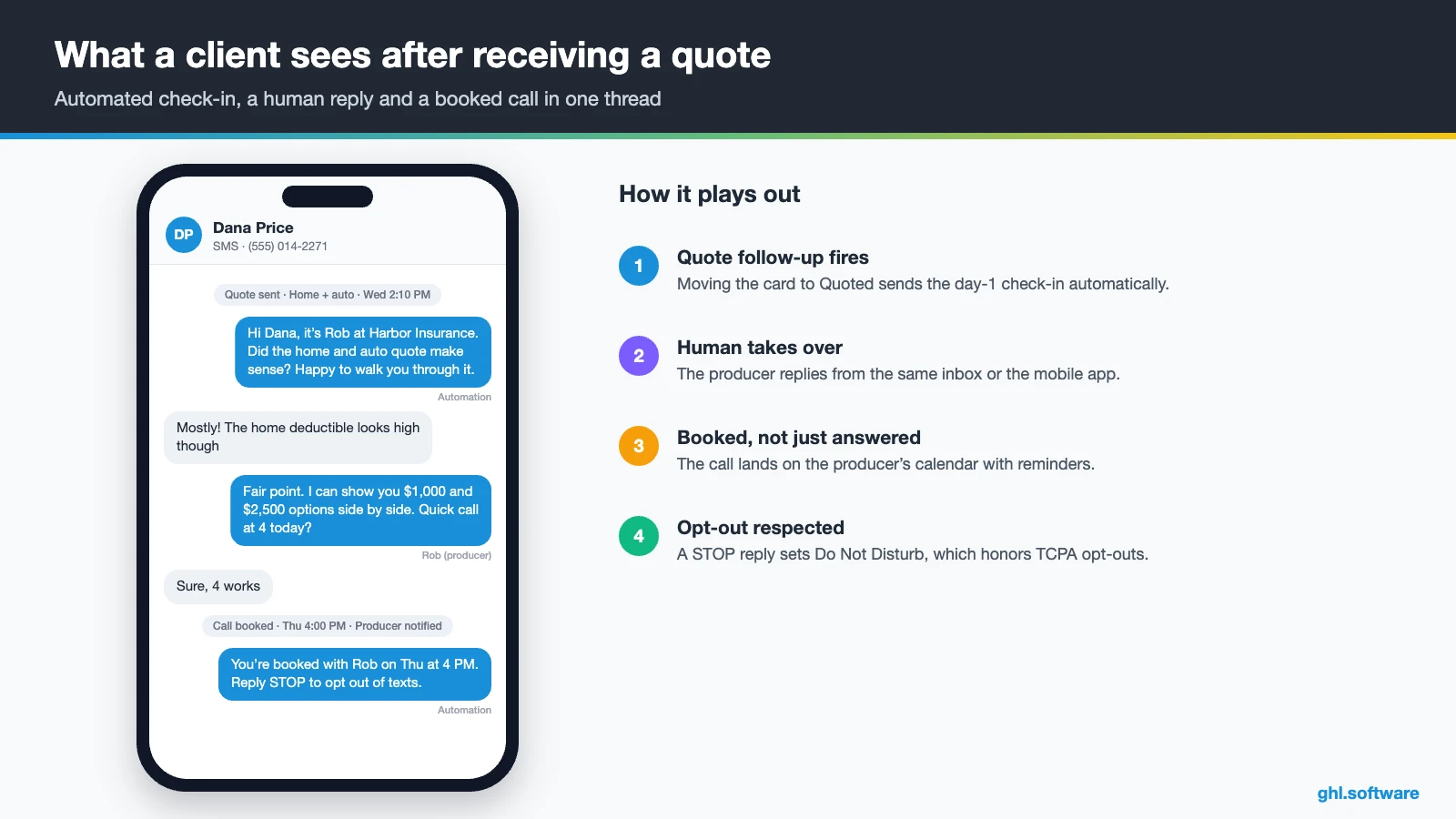
This workflow starts when an opportunity moves to “Quoted”. It emails a short recap of the quote with a link to book a call. A day later, it sends a friendly text that asks whether anything is unclear. On day three the producer gets a call task, because many insurance decisions still happen on the phone.
If the client signs or replies, the card moves on and the cadence ends. Otherwise, on day ten the household moves into long-term nurture with a monthly email. In short, no quote dies simply because nobody asked twice.

Renewal review 90 days out, then cross-sell
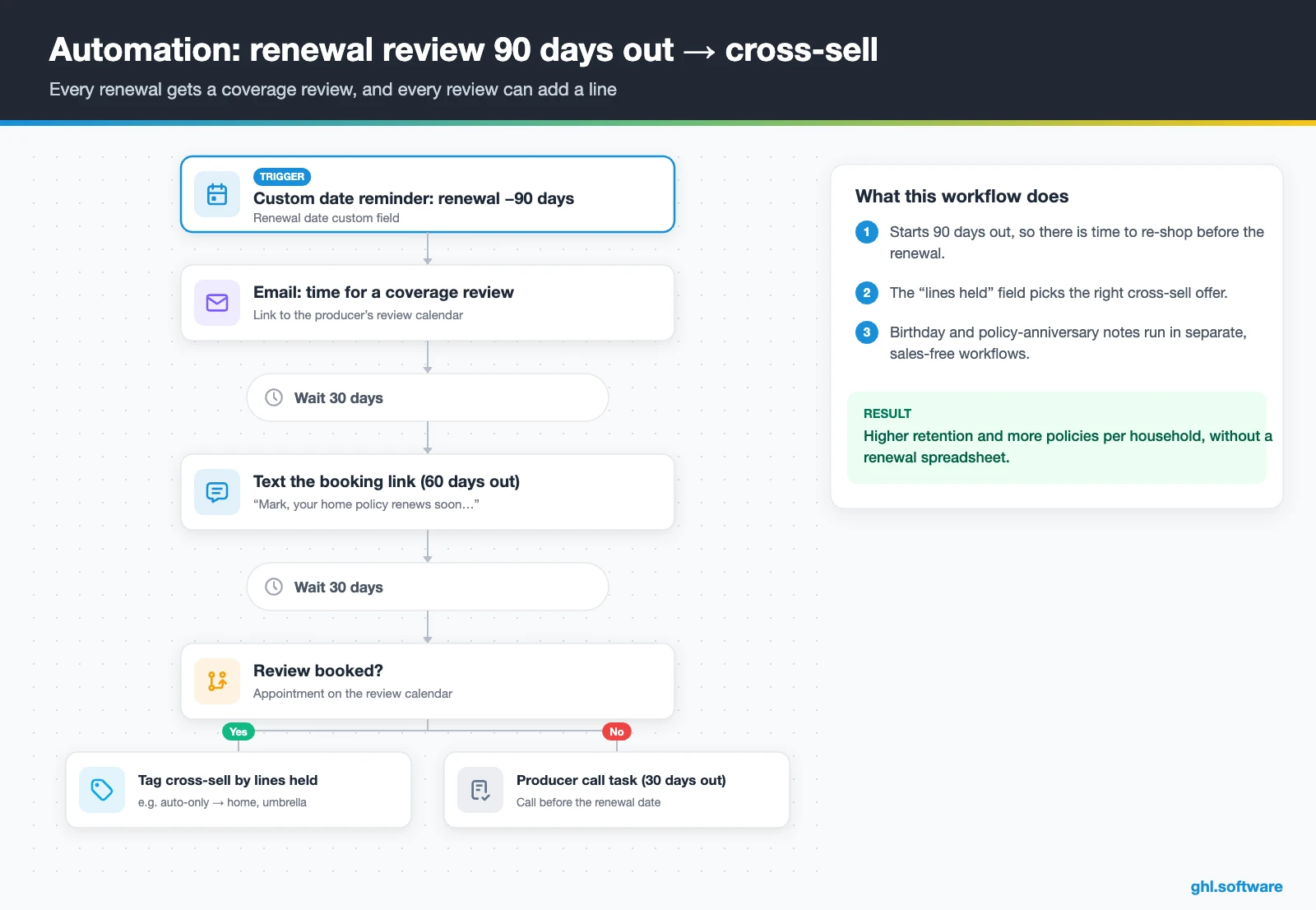
Renewals are where agencies keep or lose their book, so start early. A Custom Date Reminder trigger fires 90 days before the “Renewal date” field. Then the workflow emails the client an invitation to review coverage, with a link to the review calendar. Thirty days later a text repeats the link. If nothing is booked at 30 days out, the producer gets a call task.
After the review, a tag based on the “lines held” field starts the right cross-sell. For example, an auto-only household gets a short sequence about home, renters, umbrella or life coverage. Because the offer follows a real conversation, it feels like advice instead of a pitch.
Birthdays, policy anniversaries and referrals
The Birthday Reminder trigger sends a personal text on the client’s birthday, with no sales message at all. Meanwhile, a Custom Date Reminder on the policy issue date sends a one-year thank-you email. A week after each issued policy, every client gets a review request by SMS and email, and unhappy replies go to the agency owner. A referral ask follows a month later. Check your state’s rules before offering any referral gift.
Start with the snapshot and the pipeline from this guide, then add the automations one by one. The extended trial comes with our bootcamp link.
Start the 30-day trialAffiliate link. I may earn a commission at no extra cost to you.
Texting, Voice AI and one inbox for agents and CSRs
Clients text, call or reply to an email, often at night. HighLevel puts SMS, email, WhatsApp, Facebook and Instagram DMs and web chat in one inbox per contact. In a shared CRM for insurance agents, a CSR can pick up any thread, and a new producer sees the full history when a household is reassigned. WhatsApp also works for Spanish-speaking clients, at $10 a month per sub-account plus Meta fees.
AI covers the gaps. Conversation AI can answer common questions on chat and text, then book a call. Meanwhile, Voice AI answers the agency line after hours. Still, keep coverage advice with licensed people, and never let a bot quote a price. AI is billed per use or as a monthly plan, as our AI Employee pricing guide explains.
For the bigger picture, this video on Cody Askins’ channel has HighLevel CEO Shaun Clark explaining how insurance agents can use the CRM.
Video: How Insurance Agents Can Use GoHighLevel CRM - Explained by CEO Shaun Clark · Cody Askins
What HighLevel’s official insurance snapshots include
HighLevel publishes free playbooks with matching snapshots for P&C Insurance, Life Insurance and Commercial Insurance. They follow the same generic template used for other industries, with the names swapped. So treat them as a starter kit, not a finished CRM for insurance agents. The P&C version gives you:
- An “Insurance Agency” website with a Link in Bio page and a chat widget.
- A “Home and Auto Offer” funnel: an opt-in step, then an appointment booking page.
- The “Marketing Form – Claim Offer” form and a “Marketing Pipeline”.
- The “New Lead Nurture (Fast 5) – Claim Offer” workflow (email, SMS and a voicemail drop) and “Long Term Nurture”.
- Service calendars tagged “Insurance”, a general calendar and an event calendar for consultations.
- Voice AI prompts for call handling, appointment setting and FAQs, plus missed call text back setup.
The Life and Commercial versions swap in a “Life Insurance Offer” or “Commercial Insurance Offer” funnel and a matching website. However, none of the guides lists pipeline stages, and they name only two of the six workflows they mention. There are no quote follow-up, renewal or cross-sell workflows either. So you still build the product-line pipelines, consent fields, renewal dates and the automations above. Once it works, save your build as your own snapshot for new producers or offices.
How to set up HighLevel for an insurance agency
Follow this order when you set up your CRM for insurance agents, so routing, consent and renewals work from the first lead. A small agency can finish it in a few focused days, although A2P approval can take longer.
- Create the sub-account. Load the P&C or Life Insurance snapshot, or start blank. Decide on the HIPAA add-on before you import any health or Medicare data.
- Add producers and CSRs. Create one user per person, and limit producers to their assigned contacts.
- Connect phones and A2P. Buy local numbers, register A2P 10DLC, turn on missed call text back and assign the Voice AI agent to the agency line.
- Create custom fields. Product line, carrier, policy number, premium, renewal date, lines held, consent certificate URL, consent timestamp and SOA date.
- Import your book. Upload a CSV export from your AMS with tags by product line and status. Keep existing do-not-contact flags intact.
- Build the pipelines. Create Auto & Home, Life, Health & Medicare and Commercial pipelines with the stages above and clear lost reasons.
- Set up calendars. Add a round-robin quote-call calendar and one review calendar per producer, all with reminders.
- Turn on workflows and reporting. Publish the speed-to-lead, quote and renewal automations, connect Google for reviews, and build a producer dashboard.

What a CRM for insurance agents costs on HighLevel
HighLevel charges a flat plan price instead of a fee per producer, and every plan includes unlimited users and contacts. So a five-person agency pays the same base price as a solo agent. Usage, however, comes on top: numbers, texts, calls, email, WhatsApp and AI.
For example, take a three-producer agency on Starter ($97) with three local numbers ($3.45) and 4,000 SMS segments (about $30 plus carrier fees). Add 2,000 outbound minutes (about $33) and 20,000 emails (about $13.50). That agency lands near $180 a month, plus A2P fees. With the $97 AI plan, it reaches about $275. Medicare and health agents who need the HIPAA add-on should budget $297 a month more. Most small agencies end up between $150 and $350, and our pricing guide has the full breakdown.
GoHighLevel plans compared
| Starter | Unlimited | Agency Pro | |
|---|---|---|---|
| Price | $97/month | $297/month | $497/month |
| Annual | $970/year | $2,970/year | $4,970/year |
| Sub-accounts | 3 | Unlimited | Unlimited |
| Contacts and users | Unlimited | Unlimited | Unlimited |
| All core features | Yes | Yes | Yes |
| White label web app | Yes | Yes | Yes |
| API access | Basic | Basic | Advanced, agency-level keys |
| Rebill phone and email | No | At cost | With markup |
| Rebill AI usage | No | No | Yes |
| SaaS Mode and automated sub-accounts | No | No | Yes |
| User and agent reporting | No | No | Yes |
| Support | 24/7 | 24/7 | 24/7 |
Usage costs on top of the plan
| Item | Official price | When you pay it |
|---|---|---|
| Local phone number (US/Canada) | $1.15/month | Each number for SMS and calls |
| SMS (US/Canada) | $0.00747 per segment + carrier fees | Every text sent or received |
| Calls (US) | $0.0166/min outbound, $0.01165/min inbound | Calls through LC Phone |
| A2P 10DLC registration | $22.50 one-time (low volume) + monthly campaign fee | Before texting US numbers |
| Email (LC Email) | $0.675 per 1,000 emails | Campaigns and workflow emails |
| $10/month per sub-account + Meta fees | If you use WhatsApp inside HighLevel | |
| AI | Pay-per-use, or $50 or $97/month per sub-account | Voice AI, Conversation AI and other AI tools |
| Premium workflow steps | $0.01 per run after 100 free | Webhooks, Google Sheets, Slack, app actions |
Honest limits: HighLevel is not an agency management system
HighLevel is a strong sales and retention layer. Still, a CRM for insurance agents does not replace the systems that hold your policies. Check these gaps before you move the agency.
- No policy administration or carrier downloads. Policies, endorsements and carrier documents stay in your AMS.
- No commission tracking. There are no commission statements or reconciliation, so producer pay stays in the AMS or your accounting tool.
- No comparative rater. You quote in your rater or carrier portals, then log the premium in HighLevel.
- No built-in consent certificate capture. Store TrustedForm or Jornaya certificate links and timestamps in custom fields.
- HIPAA costs extra. Health and Medicare PHI needs the paid add-on, which is permanent once enabled.
How to pair HighLevel with your AMS
So most agencies run both: the AMS as the record and HighLevel for leads, conversations and campaigns. You can connect them through webhooks and the API, or start with a weekly CSV of renewal dates. Here is how HighLevel compares with other tools agents shortlist when they look for a CRM for insurance agents. Features change often, so confirm details with each vendor.
| HighLevel | AgencyZoom | Agent CRM | EZLynx | |
|---|---|---|---|---|
| Main job | CRM, messaging, funnels and AI in one platform | Sales and retention for P&C agencies | Insurance CRM built on HighLevel | Agency management and rating |
| Built only for insurance | No | Yes | Yes | Yes |
| Built on HighLevel | Yes | No | Yes | No |
| Is an agency management system | No | No | No | Yes |
| Best fit | Agencies wanting one flat-priced system for leads and marketing | P&C agencies, including captives, focused on producer sales | Agents who want an insurance setup done for them | Agencies that need policy records and rating |
If you already pair AgencyZoom with your AMS, keep it. HighLevel can still add funnels, WhatsApp, Voice AI and review campaigns next to it. Moreover, resellers such as Agent CRM and Onyx CRM sell HighLevel with insurance setups built in.
Compliance: TCPA consent, A2P 10DLC, HIPAA and Medicare
The angle most guides miss: make the scope of appointment a pipeline gate
Medicare agents face a rule that generic CRMs ignore. CMS rules for Medicare Advantage marketing (42 CFR 422.2264) require the scope of appointment to be agreed upon and recorded before a personal marketing appointment. It must be in writing for in-person meetings, and it stays valid for 12 months after the signature date (eCFR). Therefore a Medicare pipeline needs a gate, not just a reminder.
In HighLevel, that gate is simple. Add “SOA date” and “SOA products” fields, and make “Scope of appointment recorded” a stage before “Appointment set”. Then a workflow checks the field whenever an appointment is booked and creates a task if it is empty. A Custom Date Reminder can also flag scopes that are close to their 12-month limit. Most guides about a CRM for insurance agents skip this step entirely. Timing rules can change each plan year, so confirm current CMS guidance with your upline before you build. You can compare this setup with our other industry guides or browse the features hub.
Open a free account, load the pipeline and turn on the first automation today. The bootcamp walks you through the setup live.
Start the 30-day trialAffiliate link. I may earn a commission at no extra cost to you.
Frequently asked questions
What is the best CRM for insurance agents?
It depends on what you need most. If you need policy records, commissions and carrier downloads, you need an AMS such as EZLynx or HawkSoft. For P&C sales and retention tied to that AMS, AgencyZoom is a common pick. If you want leads, texting, Voice AI, funnels and campaigns in one flat-priced platform, HighLevel fits well, as long as you keep your AMS next to it.
What is the difference between GoHighLevel and Agent CRM?
Agent CRM is an insurance-focused product built on HighLevel, so the core platform is the same. The difference is packaging. Agent CRM ships insurance setups, training and support for agents, while plain HighLevel gives you official snapshots and building blocks that you configure yourself. Choose a reseller if you want it done for you, or HighLevel directly if you want full control and agency features.
What is the difference between an AMS and a CRM for insurance?
An agency management system holds policies, endorsements, carrier downloads and commissions. It is the book of record. A CRM handles selling and retention: leads, follow-up, appointments, texts, renewal campaigns and reviews. HighLevel is a CRM and marketing platform, so it does not reconcile commissions or download policies. Most agencies run both and sync key fields such as renewal dates.
Is GoHighLevel HIPAA compliant for Medicare and health agents?
Not by default. HighLevel offers a HIPAA add-on that comes with a Business Associate Agreement. It costs $297 a month, applies to the whole account and cannot be turned off once enabled. If you handle health information for Medicare or ACA clients, decide on it before you import data. Otherwise, keep health details out of notes, texts and form fields.
Can I text insurance leads legally?
Yes, with consent and registration. Under the TCPA, autodialed or prerecorded marketing texts and calls need prior express written consent, so store the consent proof on each contact. Texting from US local numbers also requires A2P 10DLC registration, which HighLevel handles in its Trust Center. Honor STOP replies on every channel, and check your state’s rules too.
How do I automate policy renewal reminders in HighLevel?
Store each policy’s renewal date in a custom date field. Then build a workflow with the Custom Date Reminder trigger set to 90 days before that date. It can email a review invitation, text the booking link at 60 days and create a producer call task at 30 days. When the client books, a tag stops the reminders and starts a cross-sell sequence.
How much does a CRM for insurance agents cost on HighLevel?
The Starter plan costs $97 a month with unlimited users and contacts. Usage adds the rest: $1.15 per local number, SMS segments, call minutes, email and optional AI at $50 or $97 a month. A small agency usually lands between $150 and $350 a month. Medicare and health agents who need HIPAA should add $297 a month.
More industry guides
Sources: HighLevel P&C Insurance playbook · HighLevel Life Insurance playbook · HighLevel Commercial Insurance playbook · HighLevel help: Industry playbook for insurance companies · HighLevel help: HIPAA compliance · HighLevel help: A2P 10DLC registration · HighLevel help: Missed Call Text Back · eCFR: 42 CFR 422.2264 (Medicare marketing, scope of appointment) · FCC: Telemarketing and robocalls