

CRM for Therapists: Grow a Private Practice With HighLevel
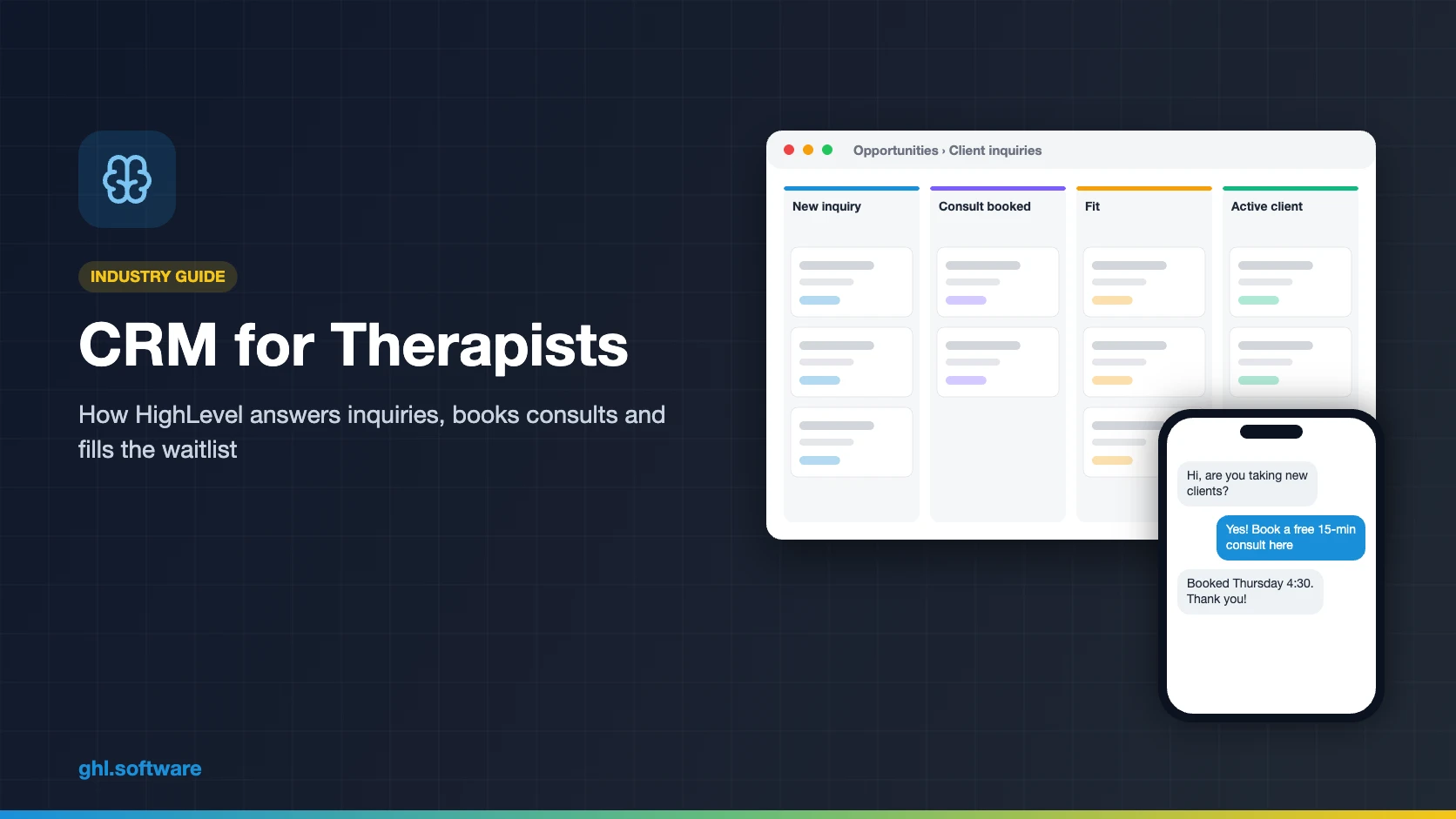
A CRM for therapists handles the work around the session: new inquiries, free consult calls, reminders, the waitlist, self-pay payments and referral partners. HighLevel does that job next to your EHR (SimplePractice, TherapyNotes or Jane), which keeps notes, treatment plans and claims. However, it is not HIPAA compliant by default, so US practices need the $297/month add-on and a signed BAA.
Tuesday, 2:10 p.m., in your Tulsa office. You are ten minutes into a session when your phone buzzes on silent, face down on the bookshelf. Jordan Ellis has finally decided to get help, found your directory profile and called. By the time your 50-minute hour ends, Jordan has booked a consult with the next therapist on the list. A CRM for therapists exists for that quiet moment. It texts Jordan a consult link within a minute, while you stay present with your client.
This guide is for mental-health practices: counselors, psychologists, MFTs, clinical social workers and group practices, not massage therapists. However, an EHR such as SimplePractice or TherapyNotes is built around the record, not the mid-session inquiry.
Below you will find the inquiry pipeline, three automations, setup steps and real costs. You will also see what HighLevel’s HIPAA add-on really covers, and why a CRM for therapists should never ask clients for reviews. This guide is part of our GoHighLevel by industry series, and medical clinics have their own CRM for healthcare guide.
Leer en español: Software para psicólogos · Ler em português: Sistema para psicólogos · Part of GoHighLevel by industry
Includes a free live setup class with a HighLevel coach.
Start free + bootcampAffiliate link.
CRM vs EHR: what a therapy practice needs from each
Think of two layers. The EHR is the clinical layer: intake questionnaires, progress notes, treatment plans, diagnosis codes and claims. A CRM for therapists is the front-office layer, from the first inquiry to the first session, plus the logistics of weekly care. Because the layers hold different data, you can keep clinical content out of HighLevel entirely. In a solo or group practice, the CRM then covers eight jobs.
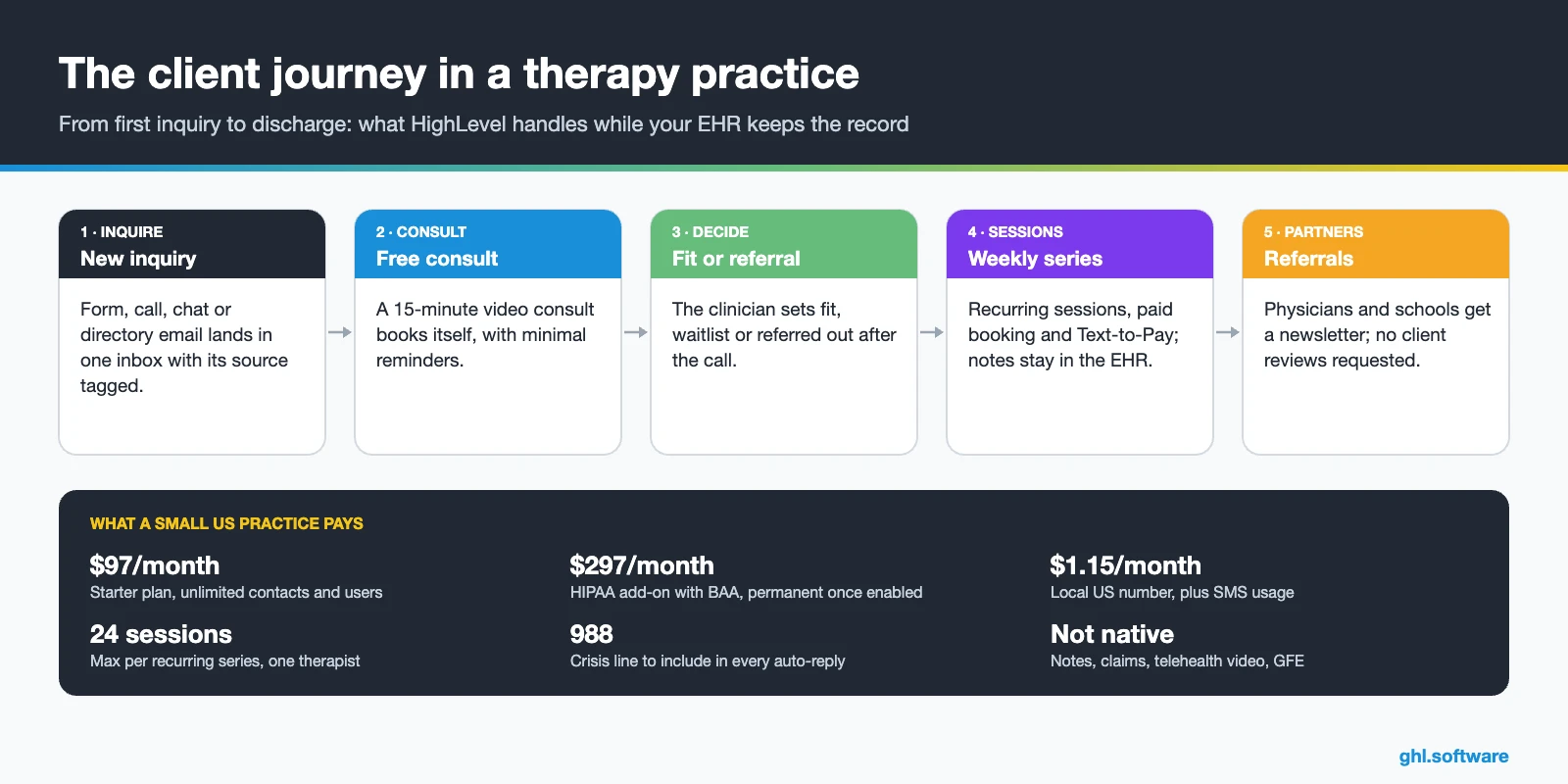
Private practice problems and how HighLevel solves them
Before you build anything, list the leaks in your week. For example, most practices recognize several of the problems below. So a good CRM for therapists should fix each one without touching clinical content.
| Problem | What HighLevel does | Feature |
|---|---|---|
| Calls missed during sessions | Texts the caller within a minute with a consult link and the 988 line | Missed call text back |
| Inquiries answered the next day | Sends an instant reply and creates a call-back task | Forms + workflows |
| Consults that never become clients | Tracks each consult to an outcome: fit, waitlist or referred out | Pipelines |
| No-shows and late cancellations | Sends minimal reminders and can take payment at booking | Calendars + payments |
| Empty slots after cancellations | Offers the opening to a matching waitlist by text | Smart lists + workflows |
| Referral sources nobody tracks | Stores each partner, their referrals and the last contact | CRM + reporting |
| Marketing that risks ethics or HIPAA | Nurtures referral partners instead of asking clients for reviews | Email marketing |
The client inquiry pipeline in a CRM for therapists
A pipeline is a board of stages, and each card is one person who reached out. In a CRM for therapists, the board shows who called this week, who had a consult and who is still deciding. Each move can also trigger the next message or task.
Still, keep the cards free of clinical detail: a name, a source, a modality and a payer type are enough. Meanwhile, the presenting concern stays in your EHR, where it belongs. Then add a second board, Referral partners, so physicians and schools never clutter the client view.
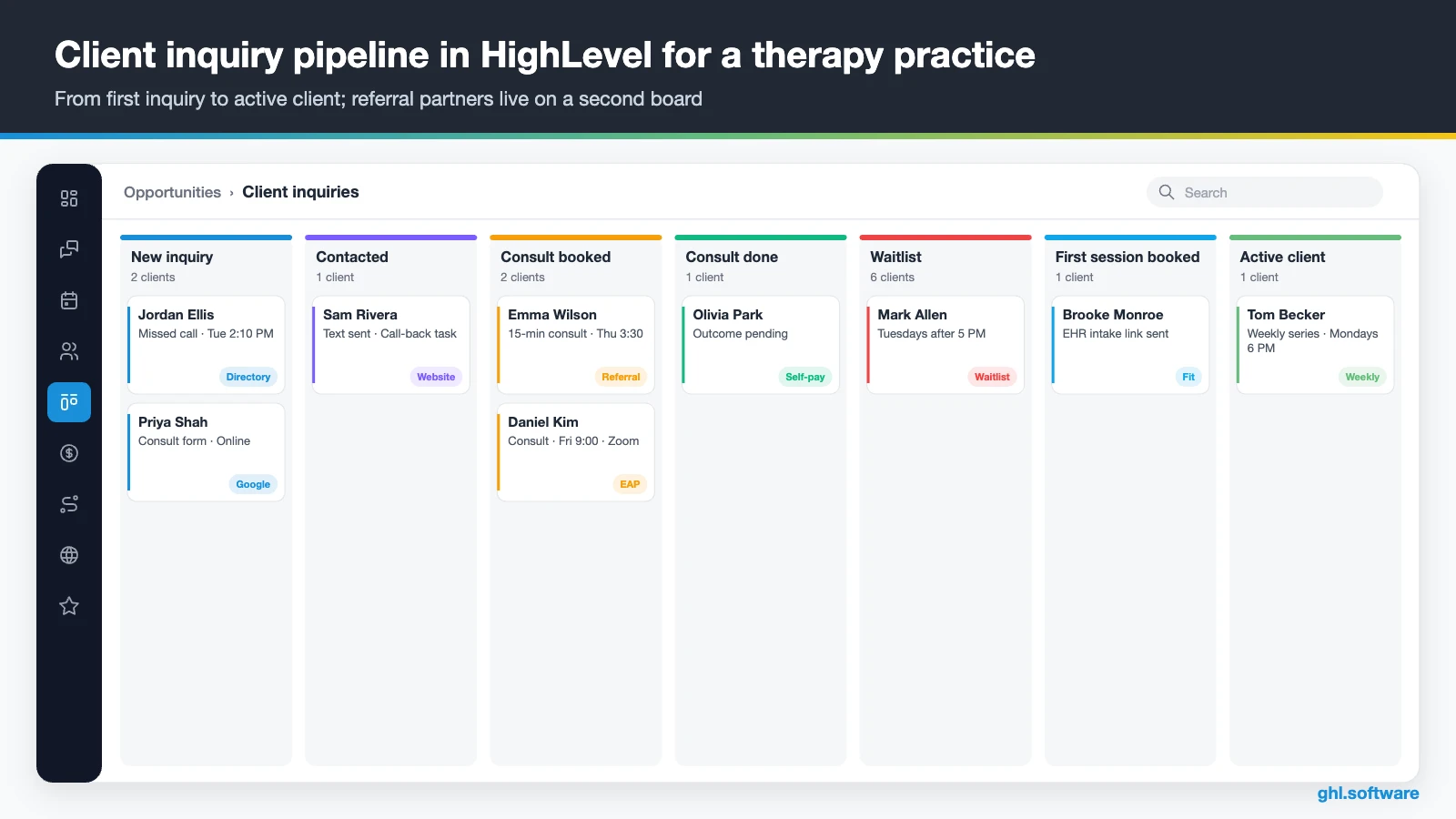
| Stage | What moves a card here |
|---|---|
| New inquiry | Consult form, missed call, web chat or directory email |
| Contacted | First reply sent or call logged |
| Consult booked | The person books the 15-minute consult (automatic) |
| Consult done | Appointment status changes to showed |
| Fit, waitlist or referred out | The clinician sets the outcome after the consult |
| First session booked | First session on the calendar; EHR intake link sent |
| Active client | Weekly series running |
| Discharged | Treatment ended; no marketing follow-up |
Three automations for a therapy practice (and one to skip)
Most CRM guides end with a review-request workflow. Here, a CRM for therapists skips it, for ethical reasons explained further down. Instead, these three automations cover speed, the waitlist and referral partners.
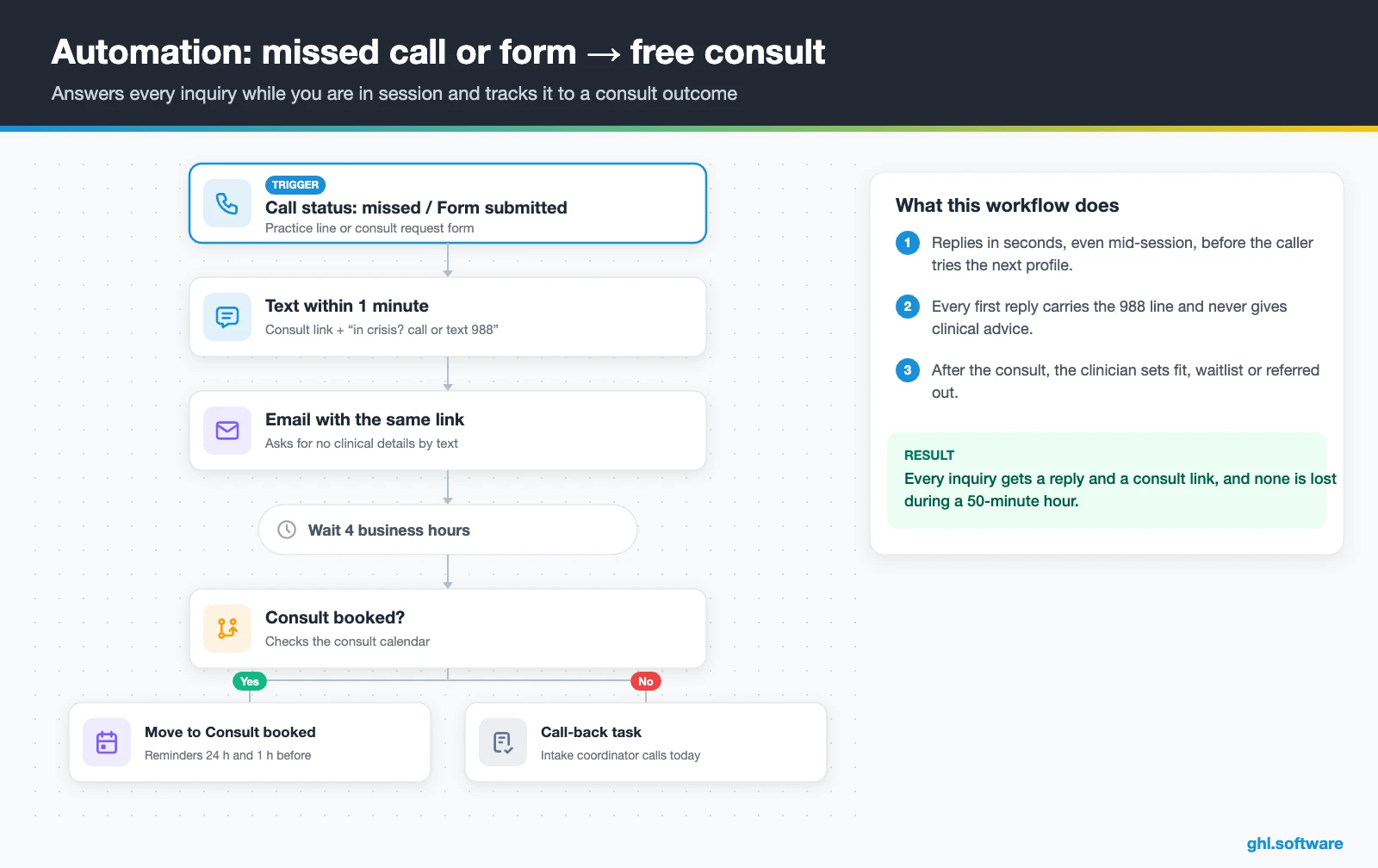
1. Missed call or form → free consult call
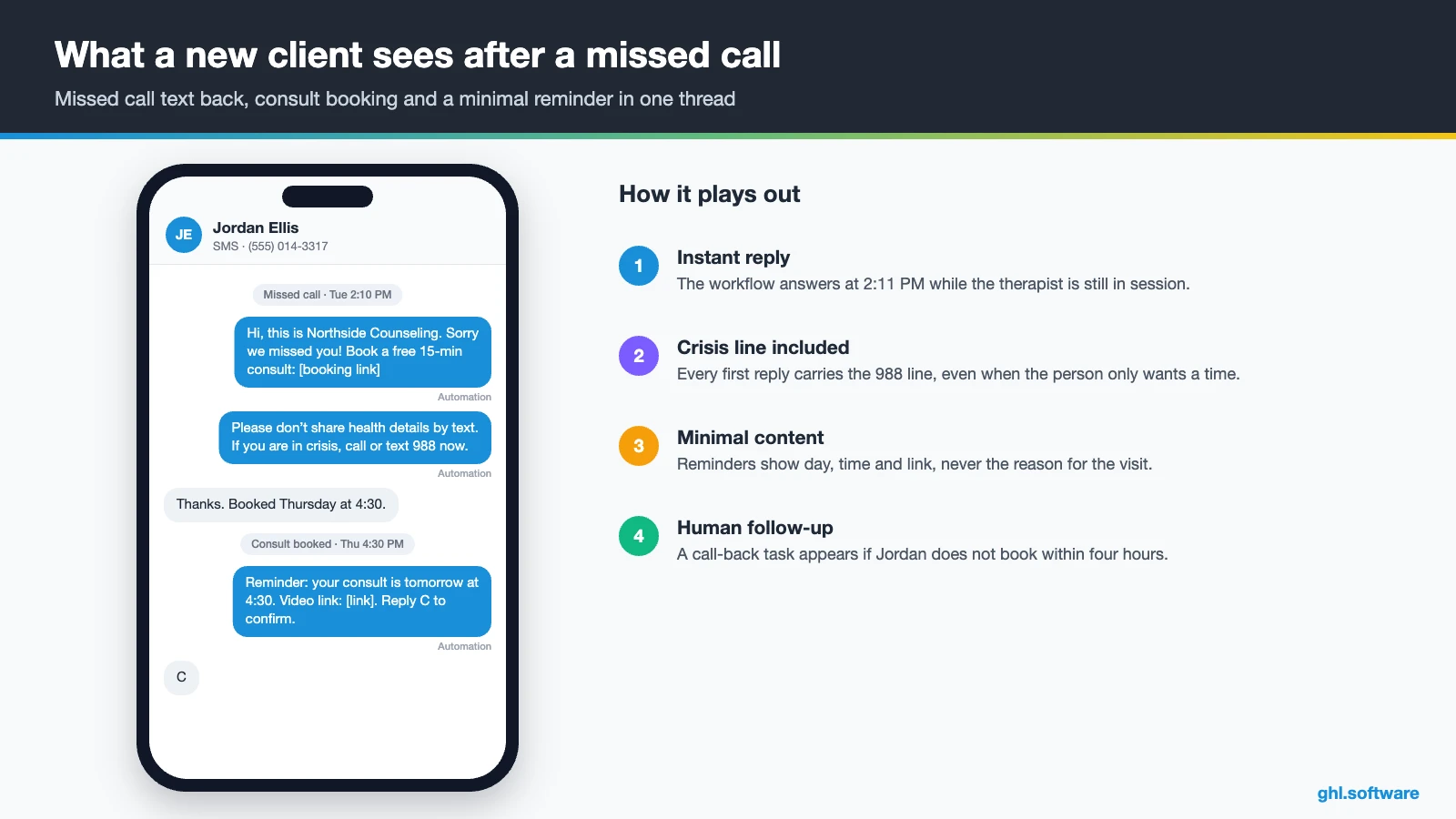
The trigger is a submitted consult form or a missed call. Then, within a minute, a text and an email share the consult link and ask the person not to send clinical details. Because some people reach out at a hard moment, the message also says: if this is an emergency, call or text 988. Meanwhile, the card opens in New inquiry with its source tagged.
If nobody books within four business hours, the intake coordinator gets a call-back task. Once the person books, reminders go out 24 hours and 1 hour before the consult. After the call, the clinician sets the outcome, and the workflow sends the EHR intake link, a waitlist note or referrals. As a result, no mid-session caller falls through the cracks.
2. Cancellation → waitlist backfill
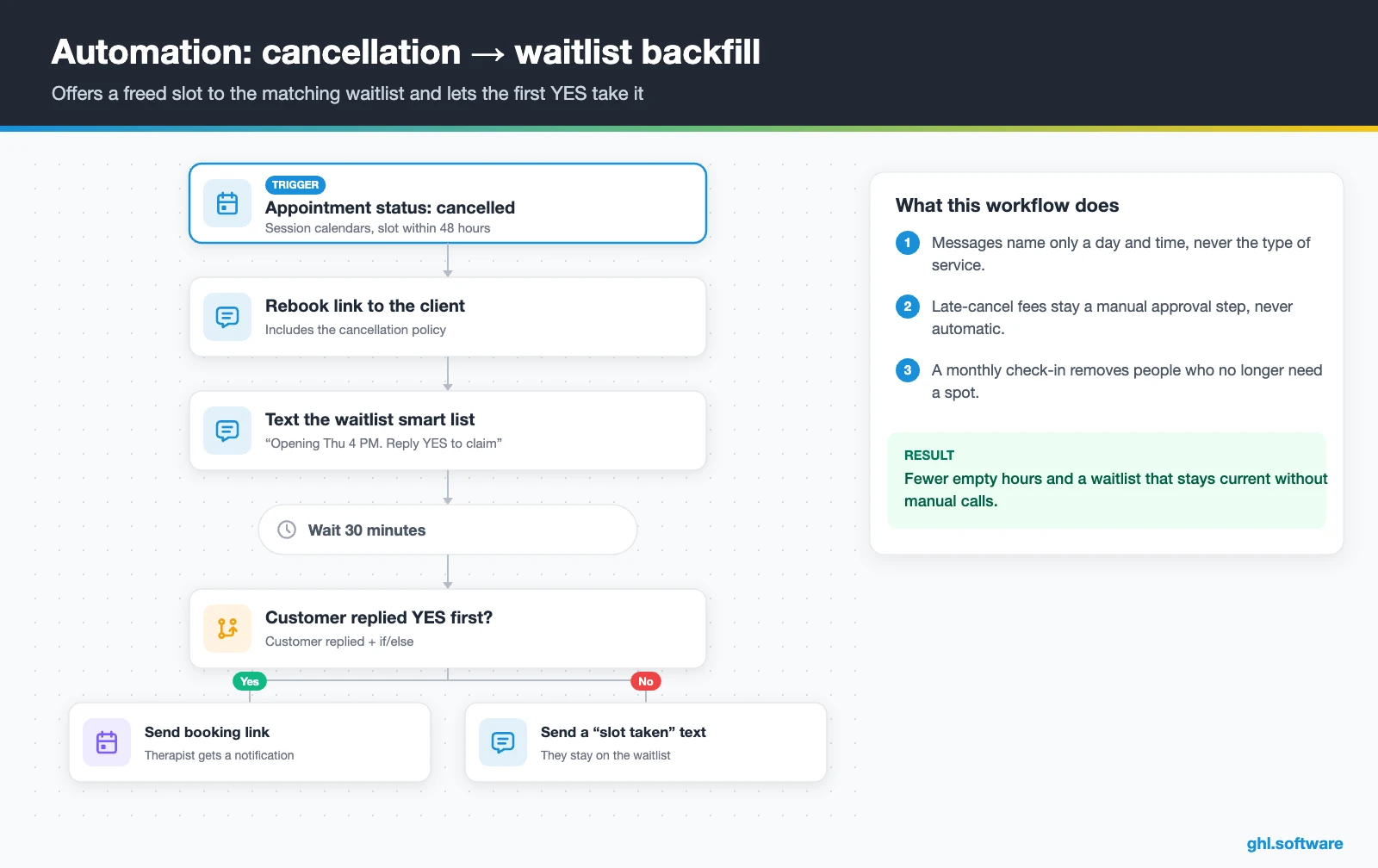
The trigger is Appointment status: cancelled. If the slot falls within 48 hours, the workflow texts the matching waitlist smart list: “An opening is available Thursday at 4 p.m. Reply YES to claim it.” The first YES, caught with a Customer replied trigger and an if/else, gets the booking link. Then everyone else hears that someone took the slot.
Meanwhile, the client who cancelled gets a rebook link and a reminder of your policy. If you charge a late-cancel fee, keep that invoice a manual approval step. Finally, a monthly check-in asks waitlist members whether they still want a spot.
3. Referral-partner nurture instead of review requests
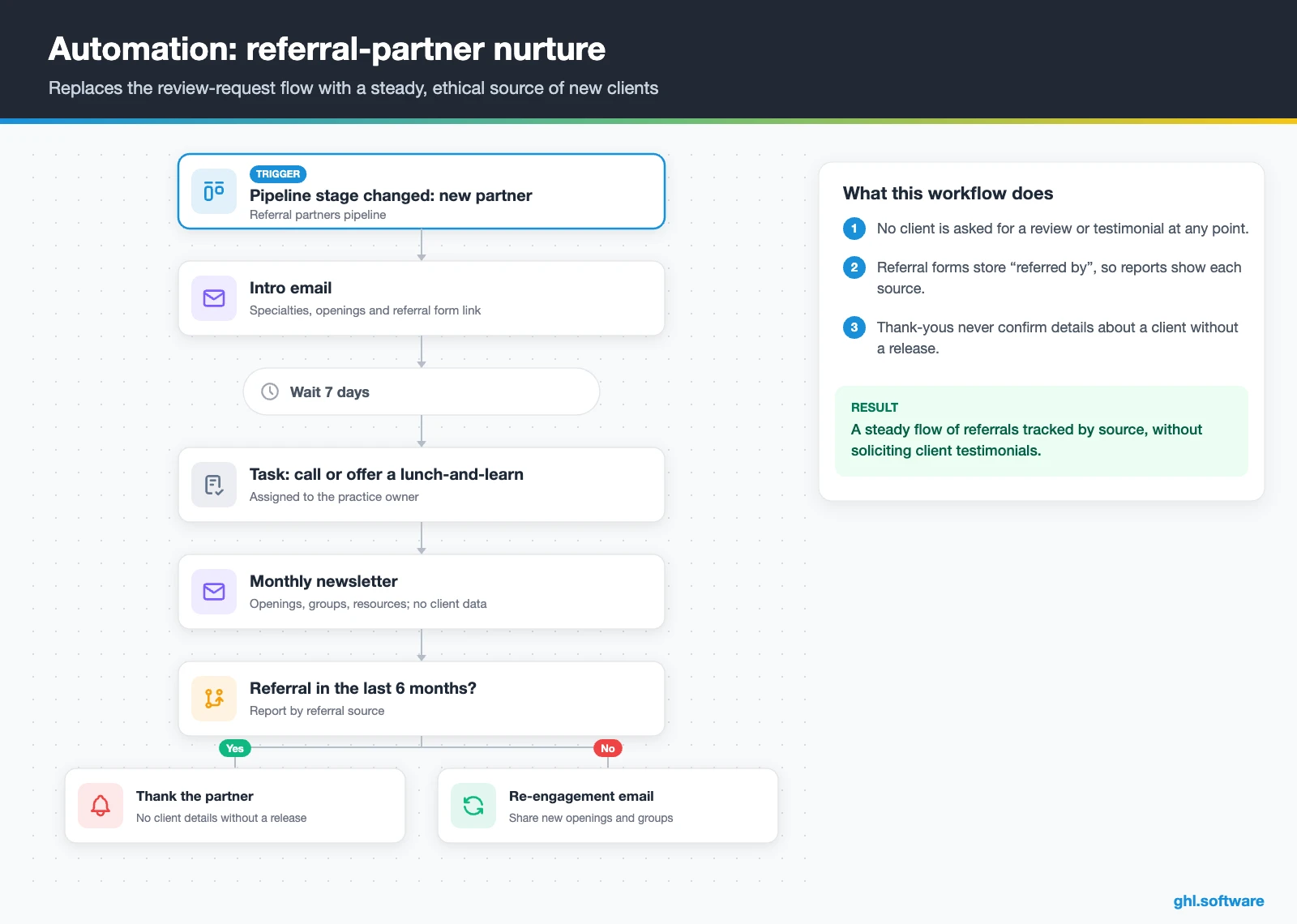
The trigger is a new card in the Referral partners pipeline: a physician, a school counselor, an EAP or another therapist. The workflow sends an intro email with your specialties and a referral form link. Seven days later, it creates a task to call or offer a lunch-and-learn. After that, a monthly newsletter shares openings and new groups, with no client information.
When a referral arrives with “referred by” set to a partner, you get a notification and the partner gets a thank-you. However, never share client details without a signed release. Each quarter, a report by source also shows which partners are active, and quiet ones receive a re-engagement email.
Start with the snapshot and the pipeline from this guide, then add the automations one by one. The extended trial comes with our bootcamp link.
Start the 30-day trialAffiliate link. I may earn a commission at no extra cost to you.
Weekly sessions, no-show policy and self-pay
HighLevel’s recurring appointments book a weekly, biweekly or custom series for one team member, with up to 24 sessions per series (HighLevel help article). However, in a custom series, workflows fire only on the first appointment, so test your reminders on a real series first.
Calendars can also take payment at booking, which suits paid consults or a deposit under a clear no-show policy.
Self-pay clients and the Good Faith Estimate
Under the No Surprises Act, uninsured and self-pay clients get a Good Faith Estimate when they schedule at least three business days ahead or ask for one. It is due within one business day for services 3 to 9 business days away, and within three for 10 or more (CMS). HighLevel has no GFE generator, so send it from your EHR. Still, a workflow can create a task when a self-pay client books.
Texting and AI in a CRM for therapists, with crisis-safe wording
Many clients prefer to confirm a time by text. HHS guidance lets providers email patients when they apply reasonable safeguards and honor the patient’s preferences (HHS FAQ). So keep every message minimal: first name, day, time and link, with no diagnosis or type of service. US texting also needs A2P 10DLC registration and consent. Meanwhile, response-time SLAs in the inbox flag threads that wait too long.
AI needs firmer limits here than anywhere else. Voice AI and Conversation AI can answer logistics, such as fees, hours or telehealth, and they can book the consult. However, they must never counsel, assess risk or triage, and they should hand off to a human whenever a message sounds urgent.
Also note that Conversation AI with Claude and Gemini models is still a Labs beta, and the “Maya” health and wellness agent is marked coming soon. Besides, the HIPAA article documents no limits on AI features, so ask HighLevel before client data passes through AI.
Is there an official HighLevel snapshot for therapists?
No. HighLevel’s playbook site lists no therapist, counseling or mental-health guide. Instead, the closest resources are the Health & Wellness playbook, with its journey Capture → Book → Confirm → Deliver → Pay → Review → Rebook, and the Chiropractor snapshot. For therapy, however, drop the Review step and add a Waitlist. The Chiropractor snapshot, in turn, follows HighLevel’s standard template:
- A “Chiropractor” website and a “Chiropractor Offer” funnel built for ad promotions.
- A “Marketing Form – Claim Offer” form, a “Marketing Pipeline” and service calendars.
- “New Lead Nurture (Fast 5)” and “Long Term Nurture” workflows with email, SMS and a voicemail drop.
- Custom values, a chat widget, snippets, a Voice AI prompt and missed call text back.
In short, the snapshot saves clicks on calendars, chat and missed calls. However, it has no HIPAA mention, its funnel assumes discount offers, and nothing in it handles consults, waitlists or referral partners. Therefore, many therapists start blank and build the pieces from this guide.
How to set up HighLevel for a therapy practice in 8 steps
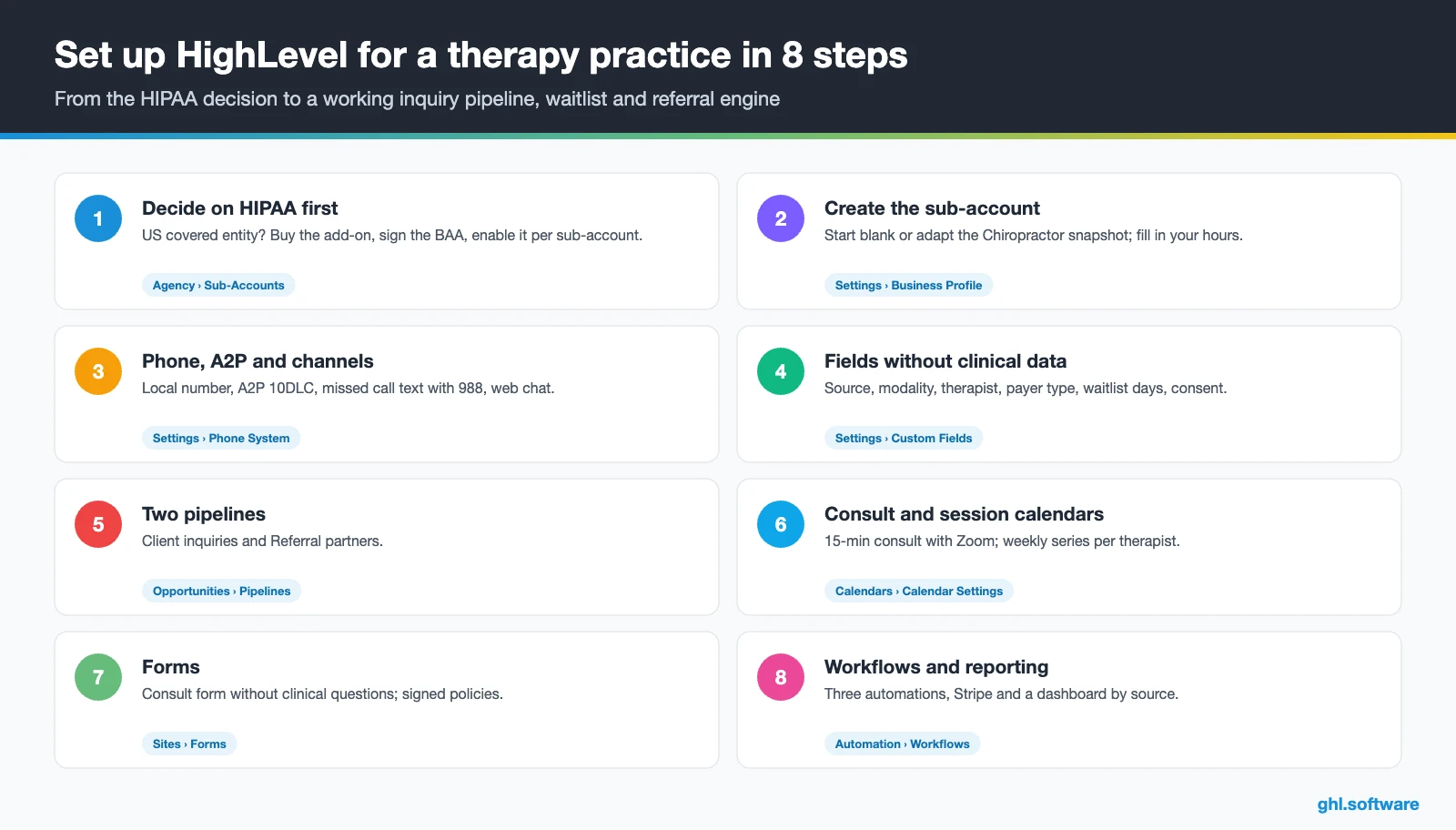
- Decide on HIPAA first. US covered entities buy the HIPAA add-on, sign the BAA under Settings › Compliance and enable HIPAA on the sub-account before any client data goes in. The toggle is permanent.
- Create the sub-account. Start blank, or load the Chiropractor snapshot and remove the offer funnel. Then fill in the business profile. See snapshots.
- Connect phone and channels. Buy a local number, register A2P 10DLC and add 988 to the missed call text. Then connect web chat, an email domain and your Google Business Profile.
- Add fields and import contacts. Create fields for source, modality, therapist, payer type, waitlist days and consent to text. Then import contacts without clinical data.
- Build two pipelines. Create Client inquiries, with the stages above, and Referral partners.
- Create the calendars. Set up a 15-minute consult with Zoom or Meet, one session calendar per therapist with recurring series, and optional paid booking.
- Add forms and policies. Build a consult form with no clinical questions and a consent-to-text checkbox, and sign policies in documents and contracts. Clinical intake stays in the EHR.
- Turn on workflows and reporting. Finally, build the three automations, test them on your own phone, connect Stripe and add a dashboard by source.
What a CRM for therapists costs on HighLevel
HighLevel charges a flat plan plus usage. A solo or small group practice usually starts on Starter at $97 per month, with all core features and unlimited contacts and users. Usage then adds a local number at $1.15 a month, SMS at $0.00747 per segment plus carrier fees, A2P 10DLC registration and LC Email at $0.675 per 1,000.
For example, an illustrative practice that sends about 600 texts a month spends roughly $105 to $120. However, a US practice that stores client data also needs the $297 HIPAA add-on, so a CRM for therapists on HighLevel realistically costs around $400 to $420 a month. Besides, AI plans at $50 or $97 per sub-account are optional. Our pricing guide and the AI Employee pricing page explain each item.
GoHighLevel plans compared
| Starter | Unlimited | Founder (formerly Agency Pro) | |
|---|---|---|---|
| Price | $97/month | $297/month | $497/month |
| Annual | $970/year | $2,970/year | $4,970/year |
| Sub-accounts | 3 | Unlimited | Unlimited |
| Contacts and users | Unlimited | Unlimited | Unlimited |
| All core features | Yes | Yes | Yes |
| White label web app | Yes | Yes | Yes |
| API access | Basic | Basic | Advanced, agency-level keys |
| Rebill phone and email | No | At cost | With markup |
| Rebill AI usage | No | No | Yes |
| SaaS Mode and automated sub-accounts | No | No | Yes |
| User and agent reporting | No | No | Yes |
| Support | 24/7 | 24/7 | 24/7 |
Usage costs on top of the plan
| Item | Official price | When you pay it |
|---|---|---|
| Local phone number (US/Canada) | $1.15/month | Each number for SMS and calls |
| SMS (US/Canada) | $0.00747 per segment + carrier fees | Every text sent or received |
| Calls (US) | $0.0166/min outbound, $0.01165/min inbound | Calls through LC Phone |
| A2P 10DLC registration | $22.50 one-time (low volume) + monthly campaign fee | Before texting US numbers |
| Email (LC Email) | $0.675 per 1,000 emails | Campaigns and workflow emails |
| $10/month per sub-account + Meta fees | If you use WhatsApp inside HighLevel | |
| AI | Pay-per-use, or $50 or $97/month per sub-account | Voice AI, Conversation AI and other AI tools |
| Premium workflow steps | $0.01 per run after 100 free | Webhooks, Google Sheets, Slack, app actions |
Limits and alternatives: keep your EHR
HighLevel is not an EHR. In fact, it has no progress or psychotherapy notes, treatment plans, diagnosis codes, superbills or insurance claims, and no client portal for clinical documents. It also has no native telehealth video; instead, it links Zoom or Meet, so pick a video vendor that signs a BAA.
There is no verified native sync with SimplePractice or TherapyNotes either. You can connect through the API and webhooks or Zapier, but then client data passes through another vendor that needs its own BAA. That is why many practices hand off at the first session by sending the EHR intake link.
| HighLevel | SimplePractice | TherapyNotes | Jane | |
|---|---|---|---|---|
| What it is | CRM, marketing and automation | Practice management and EHR for therapists | Practice management and EHR for behavioral health | Practice management and charting for clinics |
| Clinical notes and charting | No | Yes | Yes | Yes |
| Built-in telehealth video | No | Yes | Yes | Yes |
| Sales pipelines and funnel builder | Yes | No | No | No |
| HIPAA | Paid add-on with BAA | Built for covered practices | Built for covered practices | Built for covered practices |
In short, a CRM for therapists complements the EHR rather than replacing it. If your EHR already sends the reminders you need, you may not need one yet. However, if inquiries, waitlists and referral partners live on sticky notes, HighLevel fills that gap.
HIPAA on HighLevel: the add-on, the BAA and open issues
Three details matter. First, if an agency runs your account, it must be HIPAA compliant itself and sign its own BAA with your practice. Second, the “Exposed media uploads” request on HighLevel’s HIPAA ideas board showed 89 votes and the status Under review in October 2026. So never collect clinical documents through upload fields. Third, even a name plus “asked about therapy” can count as PHI, so treat every contact in a CRM for therapists as protected.
Reviews, testimonials and your ethics code
Here is the angle most guides about a CRM for therapists miss. For example, APA Ethics Code standard 5.05 says psychologists “do not solicit testimonials from current therapy clients/patients or other persons who because of their particular circumstances are vulnerable to undue influence” (APA). According to Person Centered Tech, the ACA, AAMFT and NASW codes contain equivalent limits. So an automated “rate us on Google” text is the wrong workflow here.
Moreover, replies to reviews carry a second risk. In 2023, the HHS Office for Civil Rights reached a $30,000 settlement with Manasa Health Center, a New Jersey psychiatry practice, after it disclosed patients’ diagnosis and treatment in replies to negative online reviews (HHS). In fact, even a warm “thank you for trusting us” can confirm that someone is a client.
What you can do instead
- Put a passive “Find us on Google” link on your website, without asking clients to use it.
- Run a private feedback survey with HighLevel forms and keep the answers internal.
- Grow through referral partners with the nurture workflow above.
- Turn off automatic review replies and, if you answer at all, use a generic note that confirms nothing.
Open a free account, load the pipeline and turn on the first automation today. The bootcamp walks you through the setup live.
Start the 30-day trialAffiliate link. I may earn a commission at no extra cost to you.
Frequently asked questions
Is GoHighLevel HIPAA compliant for therapists?
Not by default. HighLevel states that accounts are not HIPAA compliant out of the box. A US practice needs the HIPAA add-on, which costs $297 a month or $2,970 a year, plus a signed BAA. You then enable HIPAA on each sub-account, and that choice is permanent. Even then, the practice still owns its compliance: policies, training, minimal-content messages and no clinical uploads. If an agency runs your account, ask it for its own BAA too.
Can HighLevel replace SimplePractice or TherapyNotes?
No. HighLevel has no progress notes, treatment plans, diagnosis codes, superbills, insurance claims or client portal for clinical documents, and it has no built-in telehealth video. So keep your EHR for all clinical work. Instead, use HighLevel for what happens before and around the first session: inquiries, consult calls, the waitlist, reminders, self-pay links and referral partners. Many practices hand off at the first session by sending the EHR intake link.
Can I text appointment reminders to therapy clients?
Yes, with care. HHS guidance allows providers to communicate electronically when they use reasonable safeguards and respect the client’s preference. So collect consent to text on your consult form, register A2P 10DLC for US texting and keep every reminder minimal: first name, day, time and a link. Never include a diagnosis, the type of service or anything that reveals therapy to someone who glances at the phone.
Can I ask my clients for Google reviews?
In most cases, no. APA standard 5.05 bars psychologists from soliciting testimonials from current clients, and Person Centered Tech reports equivalent limits in the ACA, AAMFT and NASW codes. Therefore, skip the review-request workflow that other industries use, and add a passive “Find us on Google” link to your website instead. Also, never confirm a client relationship in a review reply; HHS reached a $30,000 settlement with a psychiatry practice over exactly that.
How should a CRM handle a crisis message that arrives by text?
Automations should never try to counsel. Every first auto-reply and AI agent message should say that the inbox is not monitored for emergencies and give the 988 Suicide & Crisis Lifeline: call or text 988, 24/7. Then use response-time SLAs and mobile notifications so a person reads new threads quickly. Finally, write a short crisis protocol for your team, and test the wording like any other workflow.
How much does a CRM for therapists cost with HighLevel?
HighLevel’s Starter plan costs $97 a month with unlimited contacts and users. Usage adds a local number at $1.15 a month, SMS at $0.00747 per segment plus carrier fees, and A2P registration. For a US practice that stores client data, the HIPAA add-on adds $297 a month, so a realistic total sits around $400 to $420 a month. Optional AI plans cost $50 or $97 per sub-account.
Does HighLevel work for group practices?
Yes. You can add each clinician as a user with their own permissions and calendar, then use a round-robin consult calendar so new inquiries go to whoever is free. The pipeline shows each card’s assigned therapist, and the waitlist can filter by clinician or day. Moreover, Starter includes three sub-accounts and unlimited users, so most group practices fit without upgrading. Note that each recurring series belongs to one team member.
More industry guides
Sources: HIPAA compliance with HighLevel · HighLevel ideas board: HIPAA compliance · HighLevel help: recurring appointments · Industry Playbook: Health & Wellness Business · A2P 10DLC brand and campaign registration · APA: professional considerations (Ethics Code 5.05) · HHS OCR: Manasa Health Center agreement · HHS FAQ: email with patients · CMS: Good Faith Estimate · 988 Suicide & Crisis Lifeline