

Marketing Fundamentals: Key Principles and Basics Explained

Marketing fundamentals represent the essential basic concepts and principles that every professional, entrepreneur, or student needs to master to create effective strategies for promoting, selling, and positioning products or services in the market.
Marketing is not simply advertising; it’s the strategic process of creating value for customers, communicating that value effectively, and building lasting relationships that benefit both the company and consumers. It’s the discipline that connects what your business offers with the people who need it.
Why learn marketing fundamentals? Because without a solid understanding of basic marketing principles, any campaign or strategy is destined to fail. Fundamentals are the foundation upon which all modern tactics are built, from digital marketing to traditional marketing.
The American Marketing Association (AMA) defines marketing as “the activity, set of institutions and processes for creating, communicating, delivering and exchanging offerings that have value for customers, clients, partners, and society at large.” This means that delivering value to customers and society is central to marketing. By learning marketing fundamentals, you’ll be equipped to craft strategies that attract customers, meet their needs, and build lasting customer relationships.
Think of it as learning the ABCs of marketing – once you know the basics, you can tackle more complex marketing challenges with confidence.
What Are Marketing Fundamentals?
Marketing fundamentals are the essential concepts and practices that underpin all marketing activities. They include understanding who your customers are, what they want, how to communicate with them, and how to deliver a product or service that satisfies their needs. For people searching for “marketing fundamentals,” it usually means they want to learn the basics of marketing – the time-tested principles that successful marketers and companies use to reach and persuade their target audience.
In practical terms, marketing fundamentals cover topics such as conducting market research, identifying your target market, and developing a unique value proposition. It also involves understanding the famous “4 Ps of Marketing” – Product, Price, Place, and Promotion – which are the key decision areas for any marketing strategy. These core areas help ensure you have the right product, at the right price, available at the right place, and promoted with the right message.
Importantly, marketing fundamentals emphasize a customer-centric approach. This means putting the customer’s needs and satisfaction at the forefront of your planning. Marketing is fundamentally about discovering and satisfying customer needs. If you understand what problems or desires your audience has, you can tailor your product and message to fit those needs. By mastering these basics, you can create marketing plans that attract new customers and retain existing ones through satisfaction and loyalty.
Below, we’ll break down some of the key principles of marketing that fall under the umbrella of “marketing fundamentals.” These principles provide a roadmap for anyone looking to build a solid marketing foundation.
Understanding Your Audience and Market

One of the most important fundamentals of marketing is understanding your audience and the broader market you operate in. Marketing begins and ends with the customer: you need to know who might buy your product, what they need or want, and why they make certain purchase decisions. This involves conducting market research and analyzing consumer behavior to gather insights.
Market Research & Consumer Insights.
Through surveys, interviews, or analyzing data, businesses gather information about potential customers’ preferences, pain points, and behaviors. This research helps identify market segments – groups of people sharing common characteristics (like age, location, or interests) that might influence their buying habits. Understanding these segments allows marketers to target the right audience for their product or service. For example, a company might discover through research that their ideal customers are health-conscious young adults; with that insight, they can tailor their marketing to fit that audience’s values.
Customer Needs and Pain Points
Fundamentally, marketing is about solving a customer’s problem or fulfilling a desire. Ask yourself: What problem does my product solve, or what need does it fulfill? By pinpointing customer pain points (the challenges or frustrations customers face) and needs, you can position your offering as the solution. A classic marketing concept known as the marketing concept holds that success comes from meeting customer needs better than the competition. In practice, this means always considering the customer’s perspective in your decisions. If you address your audience’s true needs, you’re more likely to earn their business and loyalty.
Segmentation, Targeting, Positioning (STP)
These are fundamental steps in crafting a marketing strategy. Segmentation means dividing the broader market into smaller groups of consumers with shared characteristics. Targeting is deciding which of those groups you will focus on (the ones most likely to be interested in your product). Positioning involves designing your product and message to appeal to that chosen target segment, highlighting how you fulfill their needs in a way competitors don’t. For instance, an entrepreneur launching a new eco-friendly water bottle might segment the market into groups (athletes, office workers, travelers, etc.), target environmentally conscious consumers, and position the bottle as the sustainable, convenient choice for hydration on the go. This STP process ensures your marketing efforts are directed at the right people with the right message.
By thoroughly understanding your audience and market, you lay the groundwork for all other marketing activities. In fact, creating a successful marketing strategy is all about getting to know your audience and analyzing consumer behavior, then acting on that knowledge to meet your marketing goals.
When you know who you’re speaking to and what they care about, you can make informed decisions on how to design your product, how to price it, where to sell it, and how to communicate its benefits. This customer-focused approach is the cornerstone of all marketing fundamentals.
The Marketing Mix: The 4 Ps of Marketing
When people talk about marketing fundamentals, one of the first things that comes up is the marketing mix, commonly known as the 4 Ps of Marketing. These four key elements – Product, Price, Place, and Promotion – were introduced by E. Jerome McCarthy in 1960 and remain a simple but powerful framework for planning marketing strategies.
Essentially, the 4 Ps cover what you are selling, how much it costs, where it’s available, and how you promote it. Balancing these elements is critical for meeting your customers’ needs and achieving your business goals.
These 4 Ps work together as a framework. A change in one often affects the others. For example, if you decide to lower the Price, you might need to adjust your Promotion messaging to highlight the new value, or change the Place by focusing on discount retailers. If you improve your Product with new features, you might justify a higher Price and need promotions to educate customers about the enhancements. The key is finding the right balance that delivers value to customers while achieving business objectives.
Crafting a Strong Value Proposition and Brand

Another fundamental aspect of marketing is defining your value proposition and building a strong brand around it. In simple terms, a value proposition is the answer to the customer’s question: “Why should I choose your product or service over all the others?” It’s the unique value or benefit that your offering provides to customers. Your brand is how you communicate that value and the personality or reputation of your business in the eyes of consumers.
Value Proposition.
This is a clear statement of the specific benefit or value that your product delivers, and how it solves a problem or improves the customer’s life better than the alternatives. Crafting a good value proposition is a marketing fundamental because it guides all your messaging and product development. For example, if you run a meal delivery service, your value proposition might be “healthy, home-cooked style meals delivered to your door in under 30 minutes.” This statement highlights what you offer (healthy home-style meals) and why it’s valuable (convenience of quick delivery).
A strong value proposition usually focuses on the outcome or benefit for the customer (in this case, eating healthy without the hassle of cooking). It differentiates you from competitors; perhaps your competitors offer fast food, whereas your service is both quick and healthy, which is your unique value.
Brand Identity.
Once you know your value proposition, you need to communicate it consistently through your brand. Your brand isn’t just a logo or a name – it’s the overall impression and feeling people associate with your business. It includes your brand messaging, tone, visuals, and values.
Building a brand means deciding how you want to be perceived. Are you a fun and youthful brand, or professional and trustworthy? Every piece of communication (your website text, social media posts, customer service style, packaging design, etc.) should reflect that identity. For instance, Apple’s brand is about innovation and sleek design, which comes through in everything from their advertising down to the minimalist packaging. As a fundamental, maintaining a consistent brand builds recognition and trust. Customers come to know what you stand for, which can set you apart in a crowded market.
Differentiation.
A core marketing principle is differentiation – making sure your audience understands what makes you different (and better) compared to competitors. This ties closely to both value proposition and brand.
It’s not enough to have a great product; you must clearly communicate its unique benefits. Maybe your restaurant uses only locally sourced ingredients, or your software has a feature no one else offers – highlight that! Part of mastering marketing fundamentals is learning how to position your product in the market so that its uniqueness is obvious. This could be through a catchy slogan, a compelling story, or demonstrable results. For example, the brand TOMS differentiated itself in the shoe market by promoting its one-for-one charity model (for every pair of shoes bought, a pair was donated to someone in need). This social mission was a key differentiator that resonated with customers and became central to TOMS’ brand identity.
Trust and Credibility.
Along with differentiation, building trust is fundamental. Consumers are more likely to buy from brands they trust. Marketing basics teach us to use things like testimonials, reviews, case studies, guarantees, and transparent communication to establish credibility. If you’re an entrepreneur, you might not have a big name brand yet, but you can still build trust by showcasing customer testimonials on your site, being responsive on social media, or offering a money-back guarantee. A trustworthy brand combined with a clear value proposition is a powerful foundation for effective marketing. It reassures potential customers that your product will deliver on its promises.
Remember, your brand and value proposition work hand-in-hand: the value proposition defines the promise of value, and the brand is how you deliver and message that promise consistently. By clearly defining these elements, you make it easier for your target audience to understand what you offer, why it’s relevant to them, and why they should feel confident choosing you. In competitive markets, a well-crafted brand that stands out and resonates with your audience can be the deciding factor for customers.
(It’s important to set your brand apart from competitors to give customers what they want. Through marketing, communicate your product’s unique benefits, your mission and values, and how you will improve the customer’s life.)
Marketing Channels and Strategies (Reaching Your Audience)
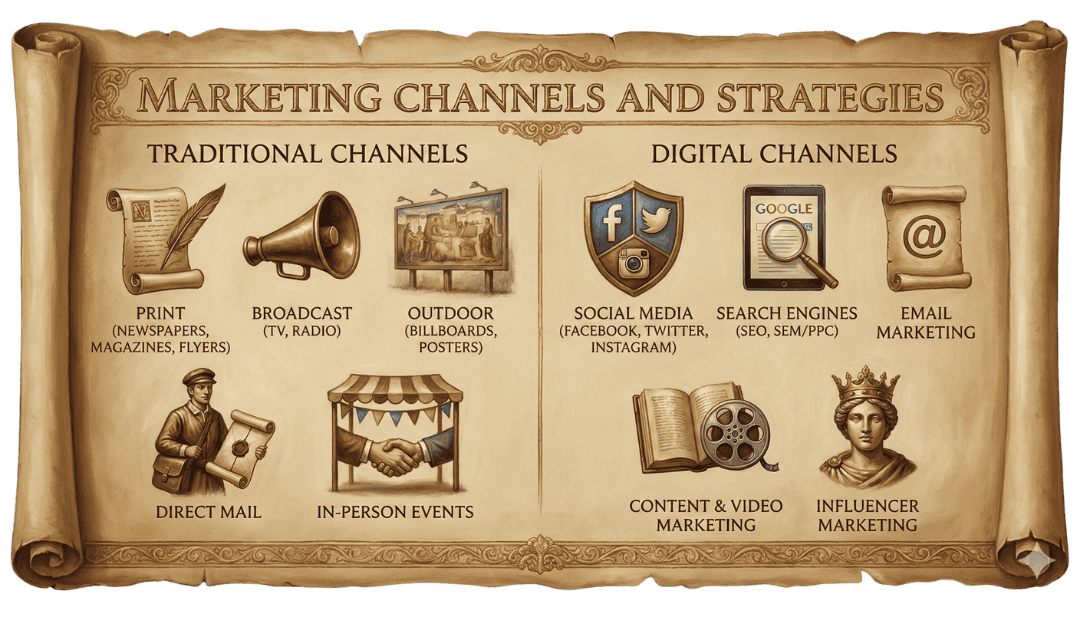
Having a great product at the right price and a strong brand message won’t help much if people never hear about it. That’s why choosing the right marketing channels and strategies to reach your audience is a fundamental part of marketing. In today’s world, there is a mix of traditional and digital marketing channels available. A good marketer understands the options and picks those that best connect with their target customers.
Traditional Marketing Channels
These include older, offline methods that have been used for decades. Examples are print advertising (newspapers, magazines, flyers), broadcast advertising (TV and radio commercials), outdoor advertising (billboards, posters), direct mail (postcards, catalogs sent to homes), and in-person events or networking (trade shows, community events, seminars).
Traditional channels can still be very effective, especially for reaching local audiences or demographics that spend less time online. For instance, a local bakery might find success by distributing flyers in the neighborhood (direct mail) or sponsoring a community event (building local awareness). The key is to match the channel to your audience’s habits – if your target customers commute via highways, billboards might be effective; if they attend industry conferences, events, and print brochures might work.
Digital Marketing Channels
These are online methods and have grown massively in importance. Key digital channels include social media (like Facebook, Instagram, Twitter, LinkedIn, TikTok), search engines (Google Search results – which you can influence via SEO or buy ads on via SEM/PPC), email marketing (sending newsletters or promotional emails), content marketing (creating valuable content like blog posts, videos, or infographics to attract an audience), video marketing (YouTube or TikTok content), and influencer marketing (partnering with popular personalities online).
Each digital channel has its strengths. For example, social media marketing allows for engaging two-way communication and community building, while SEO helps capture people actively searching for topics related to your product. A startup might use Instagram and TikTok if they have a very young audience, or LinkedIn if targeting professionals. Email marketing is often cited as a high ROI channel because it lets you directly reach people who have expressed interest (like subscribers) with tailored messages. The advantage of digital channels is that they can be very targeted (you can often specify the demographics or interests of who sees your ad) and measurable (you get data on views, clicks, etc., which helps in adjusting strategies).
Content Strategy
No matter which channel you use, having a good content strategy is fundamental. Content refers to the actual material you publish or share – text, images, videos, etc. Effective content is usually informative, engaging, or entertaining (and ideally, all three). Providing valuable content helps attract potential customers by addressing their interests or problems. For instance, a company selling gardening tools might run a blog with tips on gardening – this attracts garden enthusiasts (potential customers) to their website.
Content marketing works hand-in-hand with other channels (you share the content via social, optimize it for search engines, mention it in emails, etc.). As a fundamental, remember that quality content builds trust and authority – if people see you as a helpful or knowledgeable source, they’ll be more inclined to become customers.
Integrated Marketing
Often, the best approach is a mix of channels working together. This is sometimes called an integrated marketing strategy. The idea is to create a consistent message across all the places your audience might encounter your brand. For example, you might launch a new product with a combination of a press release (PR), an email announcement to subscribers, social media posts, and a series of YouTube tutorial videos – all carrying the same core message or theme.
Using multiple channels increases your reach (since some people might prefer one platform over another) and reinforces the message through repetition. However, it’s fundamental to maintain consistency in your branding and information so as not to confuse customers. Integrated campaigns can be very powerful; think of how big brands roll out new movies or smartphones with TV ads, online buzz, billboard ads, and influencer partnerships all at once.
Understanding Channel Effectiveness
A fundamental consideration is figuring out which marketing channels are most effective for you. This often requires some trial and error, as well as looking at data (which we’ll touch on in the next section on measurement). If you’re a small business or entrepreneur, you might start with a couple of channels that you suspect your audience uses most (say, Facebook and local newspaper ads) and see how they perform.
Over time, you can refine your strategy: invest more in what works and drop what doesn’t. Keep in mind the customer journey – often a person needs to see your message multiple times in different places before they act (they might discover you via a Google search, then later see a social media post, then finally click an email or ad to purchase). So, the channels often work together rather than in isolation.
By learning the fundamentals of various marketing channels and strategies, you can choose the right tools to reach your target audience effectively. Modern marketing fundamentals encourage leveraging the diverse mix of channels available – from traditional word-of-mouth to the latest digital platform – in order to meet your audience where they are.
The end goal is to make sure that your great product and message actually connect with the people who need to hear it. In the digital age, even small businesses have access to powerful channels (like social media or search engine ads) that can amplify their reach without enormous budgets, making marketing more accessible than ever to those who understand the basics.
Building Customer Relationships and Loyalty

Acquiring new customers is only one part of successful marketing. Keeping customers happy and loyal is just as important – and this is another marketing fundamental. Building strong customer relationships can turn first-time buyers into repeat customers and even into brand advocates who recommend your business to others. Remember, marketing isn’t just a one-time transaction; it’s an ongoing process of engagement. Here’s how focusing on relationships plays into the fundamentals:
Customer Satisfaction
At the core of customer retention is ensuring that the customer is satisfied (or better yet, delighted) with their purchase and overall experience. A fundamental marketing concept often taught is that it’s cheaper to retain existing customers than to acquire new ones.
Satisfied customers are more likely to buy again, and they might also spread positive word-of-mouth. Marketing basics, therefore, emphasize delivering on promises – the product should meet or exceed expectations, and the buying experience should be smooth.
Everything from the quality of your product to how helpful your customer service is will impact satisfaction. For example, if a customer has a question or issue, a quick and helpful response from your support team can leave a very positive impression and reinforce their trust in your brand.
Engagement and Communication
Engaging with customers even after the sale is a key part of relationship-building. This can be through email newsletters, social media interactions (replying to comments, thanking people for shout-outs, etc.), loyalty programs, or community-building efforts.
The idea is to keep the conversation going and make customers feel valued. For instance, a small business might send a follow-up email thanking the customer for their purchase and perhaps offering a discount on the next purchase as a token of appreciation. Social media allows for a more casual, ongoing engagement; you can share useful tips, respond to customer posts, and create a community around your product or niche. By helpfully staying on customers’, you increase the chances they’ll return.
Customer Loyalty and Advocacy
As you foster relationships, some customers may become loyal fans of your brand. These are people who repeatedly choose your product and may even advocate for it to friends and family. Encouraging loyalty can involve loyalty programs (like a coffee shop punch card: buy 9 coffees, get the 10th free), personalized offers (special discounts on a customer’s birthday), or early access to new products for your best customers.
Advocacy means customers actively recommending your brand; essentially, free promotion via word-of-mouth or social media. This is incredibly powerful because people trust recommendations from peers more than advertising. An entrepreneur might notice a few enthusiastic customers frequently praising their product online; nurturing these relationships (perhaps by featuring them in testimonials or giving them referral bonuses) can amplify their advocacy. Fundamentally, happy customers are the best marketers for your brand.
Customer Feedback
Building relationships also means listening to your customers. Encourage feedback through reviews, surveys, or direct conversations. Knowing what customers like or dislike can guide improvements and new ideas. It makes customers feel heard and valued when a business responds to their feedback.
For example, a software company might add a new feature that many users requested – when they announce the update, they not only improve the product but also show that they care about their user community’s opinions. This two-way interaction is part of modern marketing fundamentals: treat marketing as a dialogue, not a one-way broadcast.
The Marketing Funnel and Post-Sale Stages
You might be familiar with the idea of a marketing funnel or customer journey, which starts with Awareness (when a person first learns about your brand) and ideally continues to Interest, Decision, Purchase, and then post-purchase stages like Loyalty and Advocacy.
Marketing fundamentals cover not just how to get a customer to buy (the upper and middle of the funnel) but also how to handle the later stages. Ensuring a good experience leads to loyalty (repeat business) and possibly advocacy (customers recommending you to others).For instance, after someone buys a car from a dealership, good marketers will follow up with service reminders, satisfaction surveys, and loyalty rewards to keep that customer engaged for future purchases or referrals.
In summary, marketing doesn’t end at the sale; retaining customers and maximizing their lifetime value is a fundamental principle. By focusing on relationships, companies can build a solid customer base that provides steady revenue and can even help bring in new customers through referrals. For students or entrepreneurs, it’s important to understand that marketing success isn’t just measured in new customer acquisition, but also in customer lifetime value, retention rates, and customer satisfaction. A strong base of loyal customers can be a competitive advantage that sustains your business over the long run.
Measuring Success and Adapting (Continuous Improvement).

The last key marketing fundamental we’ll discuss is the importance of measurement and continuous improvement. In the fast-paced world of marketing, you can’t just set a plan and forget it. Successful marketers measure the results of their efforts and use that data to adjust strategies for better outcomes. This feedback loop of testing, learning, and improving is fundamental to modern marketing, especially with the abundance of data available in digital marketing.
Key Performance Indicators (KPIs)
First, you need to decide what metrics or KPIs are most relevant to your goals. KPIs are measurable values that indicate how well you’re achieving key objectives. For marketing, common KPIs include things like sales revenue, number of leads, conversion rate, website traffic, click-through rate on ads or emails, social media engagement, or customer acquisition cost. For instance, an online store might track the conversion rate of visitors to buyers and the average order value as key metrics. A nonprofit might track how many sign-ups or donations a campaign generates. By identifying the right KPIs, you know what success looks like in numeric terms.
Analytics and Tools
Thanks to technology, even small businesses have access to powerful analytics tools. Website platforms often have built-in analytics (like Google Analytics for websites) that show how visitors behave on your site, where they come from, and which pages are most popular. Social media platforms provide engagement stats for your posts. Email marketing services show open and click rates.
By analyzing these data, you gain insight into what’s working and what isn’t. For example, you might find that one of your Facebook ads has a much higher click-through rate than others, indicating that its content or image resonates better, and thus you might allocate more budget to that ad or create similar content. Data takes the guesswork out of marketing: rather than assuming a strategy is effective, you can see evidence in the numbers.
ROI – Return on Investment
A fundamental concern, especially for entrepreneurs and businesses, is ensuring that the money and time spent on marketing is yielding results. Return on Investment (ROI) is basically looking at the outcomes (like revenue or profit) relative to what you spent on a marketing activity. If a marketing campaign costs $1,000 and generates $5,000 in new sales, that’s a good ROI. If it costs $5,000 and generates $1,000, that’s a poor ROI.
By measuring ROI, you can make smarter decisions about where to invest your marketing resources. You might find that certain channels (say, email marketing or a specific advertising campaign) deliver a better ROI than others. Fundamentals of marketing management teach budget allocation based on these performance insights. Always ask: Is this marketing effort bringing in results proportional to its cost? If not, consider adjusting or trying a different approach.
Continuous Improvement
Once you have measurements, the next fundamental step is to adapt and improve. Marketing is not static; consumer preferences, market trends, and competitive landscapes change constantly.
A fundamental mindset is to view your marketing plan as a living project that you continually tweak. Perhaps your analysis shows that your message isn’t connecting with a certain segment of your audience – you might then tweak your messaging or target a different segment. Or maybe one social media platform isn’t yielding engagement while another is thriving – you could shift focus to what works better.
This process is often called optimization. For example, in digital marketing, practitioners will run A/B tests (comparing two versions of an ad or a webpage to see which performs better) and then implement the winning version. Over time, these incremental improvements can significantly boost your overall results.
Staying Current
Part of adaptation is also staying up-to-date with marketing trends and technologies. While the core principles of marketing remain steady, the tools and tactics evolve (for instance, the rise of social media or AI in marketing). A good practice is to keep learning – read marketing blogs, follow industry news, or even take refresher courses.
As mentioned earlier, a good marketer never stops learning; they watch for changes in consumer behavior, emerging platforms, or new techniques. Adapting doesn’t only mean fixing what’s not working, but also innovating and trying new ideas as the landscape changes. For instance, in recent years, strategies like influencer marketing or short-form video content (e.g., TikTok) have become important – businesses that learned and adapted to these trends gained an edge in reaching younger audiences.
By continuously measuring and improving, you make sure that your marketing efforts are effective and efficient. You’re not just doing marketing for the sake of it; you’re doing what works. This data-driven, iterative approach is a fundamental part of marketing in the modern era. It ensures that you can maximize your return on marketing investments and keep growing. In fact, regularly tracking key performance metrics and adjusting your marketing strategy based on data insights is crucial for ongoing success. In essence, plan, execute, measure, learn, and adjust – that’s the cycle that drives continuous marketing improvement.
By now, you should have a solid understanding of marketing fundamentals – from grasping the importance of knowing your audience and mastering the 4 Ps, to building a strong brand, choosing the right channels, nurturing customer relationships, and continually improving your efforts. These basics form the foundation of effective marketing. With a firm grasp of these principles, you’ll be well-prepared to develop successful marketing strategies and adapt to the ever-changing world of business and consumer behavior.
Marketing is both an art and a science – and like any discipline, it all starts with mastering the fundamentals. Good luck on your marketing journey!