

The online learning industry has undergone a radical metamorphosis over the last decade. What began as an experimental frontier for digital early adopters has consolidated into a robust economic sector projected to exceed one trillion dollars in global valuation by 2032. However, the prevailing narrative in 2025 is no longer one of a “gold rush” for easy courses; the market has matured, and with that maturity comes an unprecedented demand for quality from consumers.
In the past, the mere availability of information was a value-add. Today, in an era of content saturation and omnipresent access to free data via artificial intelligence, unstructured information is a low-value commodity. Real value, and thus sustainable business opportunity, lies in curated transformation: a creator’s ability to guide a student from a state of confusion or incompetence to a tangible, measurable result through structured pedagogy and a frictionless user experience.
This report provides an exhaustive analysis of the full lifecycle of a digital education business. We will not limit ourselves to content production; we will break down the pedagogical engineering necessary to ensure learning, the technological infrastructure required to scale operations without increasing administrative burden, and the market validation strategies that mitigate financial risk before writing the first line of code or recording the first minute of video.
Table of contents
- Market Validation Phase: Risk Mitigation and Educational “Lean Startup”
- Pedagogical Architecture and Advanced Instructional Design
- Technical Production: Audiovisual Standards for 2025
- The Tech Ecosystem: The Platform Decision
- Technical Implementation in GoHighLevel: From Setup to Launch.
- Launch Strategy, Marketing, and Pricing.
- SEO and Organic Growth: Beyond Paid Advertising
- Conclusion: The Path to Sustainability
Market Validation Phase: Risk Mitigation and Educational “Lean Startup”
The root cause of most online course launch failures is not the expert’s inability to teach, but the disconnect between the proposed curriculum and the market’s urgent needs. The traditional “build it and they will come” model is financially irresponsible in the current environment. The recommended methodology for 2025 is iterative validation, where demand is empirically confirmed before investing in mass production.
Identifying the Intersection of Value
The first strategic step is the mental transition from “passion” to “problem-solving.” While passion is necessary to sustain long-term effort, markets reward the resolution of specific problems.
The operational formula identified in the research is:
Expert Skills + Customer’s Acute Pain Point = Viable Business Idea
To discover this pain point, an audit of existing interactions must be conducted. What questions does the expert receive repeatedly on LinkedIn, via email, or in casual consultations? What specific challenge has the expert overcome that others still find insurmountable? For example, a generic course on “Productivity” has a lower probability of success than one titled “Time Management Systems for Mom Entrepreneurs Working from Home.” Specificity does not shrink the market; it increases resonance and conversion rates.
How to Identify the Right Topic
Start with these three elements:
-
- Your Expertise or Passion: What do you know well or are excited to learn more about? You don’t need to be the world’s leading expert—being a few steps ahead of your audience is enough.
- Your Ideal Student: Who specifically are you helping? The more specific, the better. Instead of “people who want to get fit,” think “busy professionals over 40 who want to lose weight without spending hours at the gym.”
- A Clear Transformation: What specific result will students achieve? Instead of “learn photography,” aim for “take professional-quality portraits using just your smartphone.”
Validate Your Idea
Before investing weeks creating content, validate demand:
-
- Search online course marketplaces to see if similar courses exist (competition is validation)
- Survey your email list or social media followers
- Check keyword search volume for your topic
- Look at related Amazon books or YouTube videos to gauge interest
- Reach out to previous coaching or consulting leads who didn’t purchase to offer your course as an alternative
Validation Frameworks and Success Metrics
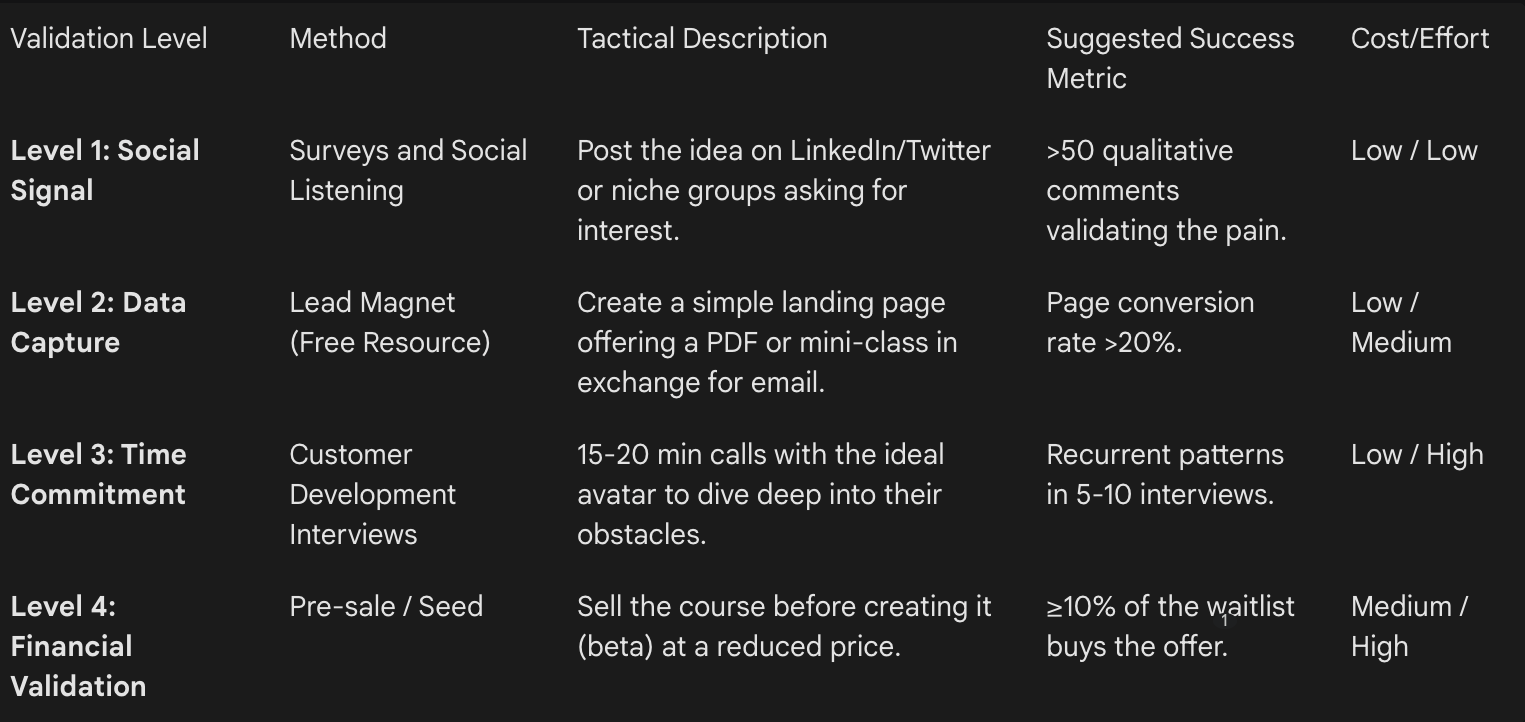
It is not enough to intuit interest; it must be measured. There are tiered validation frameworks that allow testing commercial viability with varying levels of effort and data fidelity.
Source: Learnworlds
Customer Interview Analysis:
The goal of interviews (Level 3) is not to sell, but to extract the customer’s natural language. By listening to how they describe their problems (e.g., “I feel like I’m drowning in admin tasks” vs. “I need better time management”), the creator obtains the exact material to write the copy for the future sales page. The aim is to identify not only what they want to learn but why they need it now and what they have tried before without success.
The Minimum Viable Offer (MVO) Strategy:
The MVO concept suggests launching a pilot version of the course, possibly delivered live via Zoom or through content released week-by-week. This allows the curriculum to be adjusted in real-time based on founder student feedback. Tools like GoHighLevel facilitate this immensely by allowing the rapid creation of pre-sale funnels and provisional membership areas without complex configurations.
Pedagogical Architecture and Advanced Instructional Design
Once demand is validated, the risk shifts to delivery. A course that sells well but does not teach effectively destroys the creator’s reputation and generates high refund rates. In 2025, instructional design is not optional; it is the differentiating factor that allows for premium pricing.
Design Model Comparison: ADDIE vs. SAM vs. Gagné.
The industry is primarily divided between traditional and agile approaches.
The ADDIE Model (Analysis, Design, Development, Implementation, Evaluation): This is the historical standard, favored by corporate and academic institutions for its rigor.
-
-
Advantage: Minimizes errors by exhaustively planning every detail before production.
-
Disadvantage: It is slow and linear. If an error is discovered in the Evaluation phase, the cost of going back to the Design phase is high. For an agile digital entrepreneur, ADDIE can be paralyzing.
-
The SAM Model (Successive Approximation Model): SAM is the agile response to ADDIE. It proposes an iterative cycle of rapid prototyping. Instead of planning the entire course on paper, a module is created, tested, refined, and repeated.
-
-
Practical Application: For creators, SAM is ideal. It allows launching an imperfect “Module 1,” gathering usage data (where they pause videos, which quiz questions fail), and improving the next version immediately.
-
Gagné’s 9 Events of Instruction: Regardless of the macro model (ADDIE or SAM), each lesson should follow a psychological structure to maximize retention. Robert Gagné proposed nine steps that remain valid:
-
- Gain attention (The hook).
- Inform learners of objectives (What they will learn).
- Stimulate recall of prior learning (Connect with what they already know).
- Present the content (The core material).
- Provide learning guidance (Examples, scaffolding).
- Elicit performance (Practice/Task).
- Provide feedback (Correction).
- Assess performance (Test/Quiz).
- Enhance retention and transfer (Real-world application).
Bloom’s Taxonomy and Writing Objectives
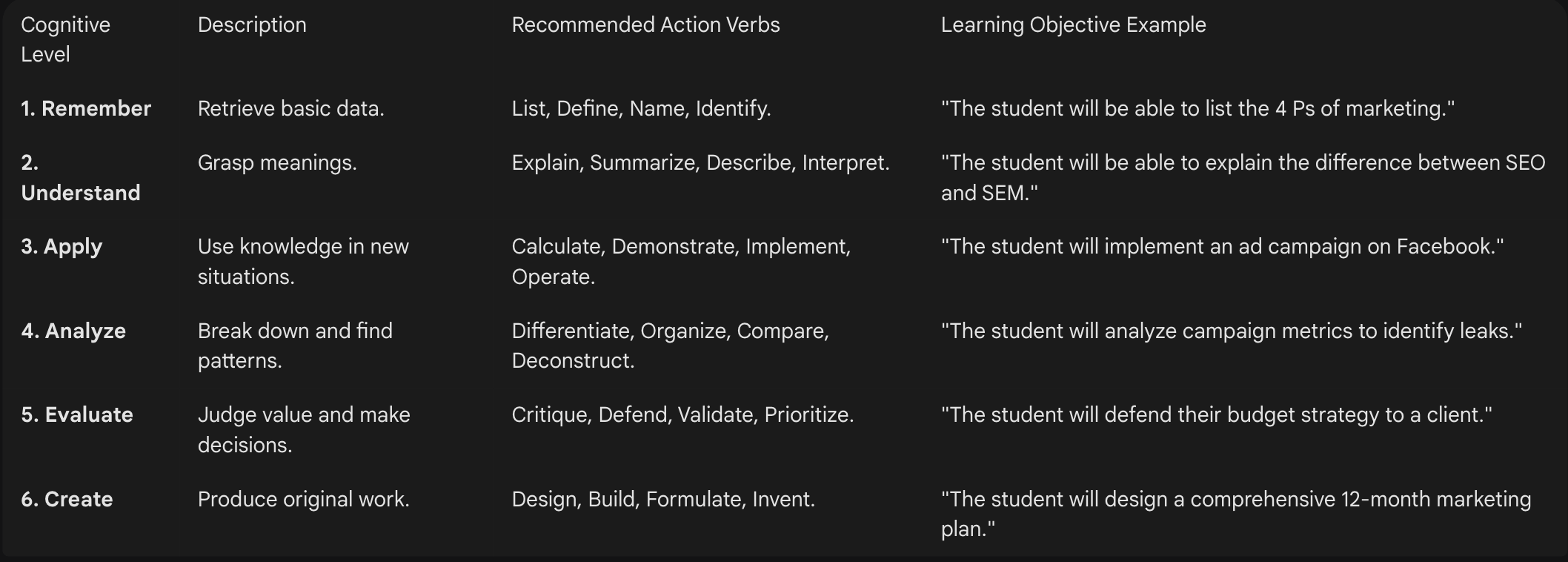
A common mistake is defining vague objectives like “the student will understand marketing.” Bloom’s Taxonomy offers a hierarchical framework for writing measurable objectives that ensure real transformation. A high-value course must move the student from lower levels to higher ones.
Retention Strategies and Micro-learning
The average completion rate for massive open online courses (MOOCs) hovers around 3-6%. To combat this, content must be fragmented. The technique of “Chunking” or Micro-learning suggests that lessons should not exceed 10-15 minutes. This aligns with the attention span of the modern adult and facilitates consumption on mobile devices. Additionally, varying formats (video, audio, text, downloadable PDF) keeps the brain stimulated and caters to different learning styles.
Gamification is another critical pillar. Advanced platforms allow configuring “points,” badges, or sequential content unlocking. For example, in GoHighLevel, it is possible to configure the system so that Module 2 remains locked until the student passes the Module 1 exam with an 80% score, thus forcing competence before advancement.
Technical Production: Audiovisual Standards for 2025
Production quality is an indicator of authority. While content is king, poor packaging (bad lighting, bad audio) devalues the perception of the product and justifies refund requests.
Audio Engineering: The Absolute Priority

Audio represents more than 50% of the video experience. A user will tolerate a pixelated image if the audio is crisp, but they will abandon the video immediately if the audio is unintelligible or fatiguing.
Microphone Selection: For most creators recording in home offices without professional acoustic treatment, dynamic microphones are superior to condenser microphones. Dynamic mics are less sensitive to background sounds (traffic, air conditioning) and room reverb.
-
Budget/Quality Option (USB/XLR): The Audio-Technica ATR2100x or the Samson Q2U. Both offer direct USB connection to the computer and XLR output for future upgrades. They have excellent noise rejection.
-
Industry Standard (Hybrid USB): The Shure MV7. Inspired by the legendary SM7B, it offers integrated digital processing (DSP) that levels the voice automatically, ideal for creators who don’t know audio engineering.
-
Professional Level (XLR): The Shure SM7B or the Electro-Voice RE20. Require a dedicated audio interface and powerful preamps. Only recommended if seeking a high-end “radio broadcast” aesthetic.
Recording Technique: It is imperative to keep the microphone close to the mouth (10-15 cm) to leverage the “proximity effect,” which gives warmth and presence to the voice. The use of pop filters is mandatory to eliminate plosives (strong ‘P’ and ‘B’ sounds).
Lighting and Visual Aesthetics

Lighting defines image quality more than the camera itself.
-
Three-Point Scheme: This is the cinematic standard.
-
Key Light: The strongest source, at 45 degrees to the face. It must be diffused (softbox) to avoid harsh shadows that age the subject.
-
Fill Light: On the opposite side, with lower intensity, to soften shadows on the nose and eyes.
-
Back Light (Hair Light): Behind the subject, pointing at the head/shoulders. It separates the subject from the background, creating three-dimensional depth and preventing the video from looking “flat.”
-
-
Budget Alternative: A large window with natural light can serve as an excellent Key Light, using a white reflector (or foam board) as fill.
Screen Capture and Editing Software.
For technical courses, screencasting software is the primary tool.
-
Camtasia: The most robust option for Windows and Mac. Allows simultaneous screen and webcam recording, and its editor is optimized for education (auto-zoom, cursor effects, annotations).
-
ScreenFlow: The premium alternative exclusive to Mac users, known for its fluidity and high export quality.
-
Loom: Ideal for quick updates or personalized feedback to students, though less powerful for editing complex modules.
-
Descript: An innovative AI-based tool that transcribes video and allows editing by deleting text in the document, automatically removing filler words (“um,” “ah”) and silences.
The Tech Ecosystem: The Platform Decision
This is where technical strategy defines the operational viability of the business. The market offers two paths: fragmentation (integrating multiple specialized tools) or unification (“All-in-One” platforms).
The Problem of Technological Fragmentation
Until recently, a creator needed a complex tech stack:
- Course Hosting: Thinkific/Teachable ($99/mo).
- Email Marketing: ActiveCampaign/ConvertKit ($49-$150/mo).
- Sales Funnels: ClickFunnels ($147/mo).
- Community: Circle/Skool ($99/mo).
- Video Hosting: Vimeo ($20/mo).
- Automation: Zapier ($30/mo). Total Monthly Cost: >$450 USD, plus the technical complexity of keeping integrations working.
The Integral Solution: GoHighLevel vs. Competition Analysis
In 2025, the trend is consolidation. GoHighLevel (GHL) has emerged as the disruptive solution integrating all the above functions into a single subscription, generally at a fraction of the combined cost.
Technical Comparison: GoHighLevel vs. Kajabi vs. Teachable
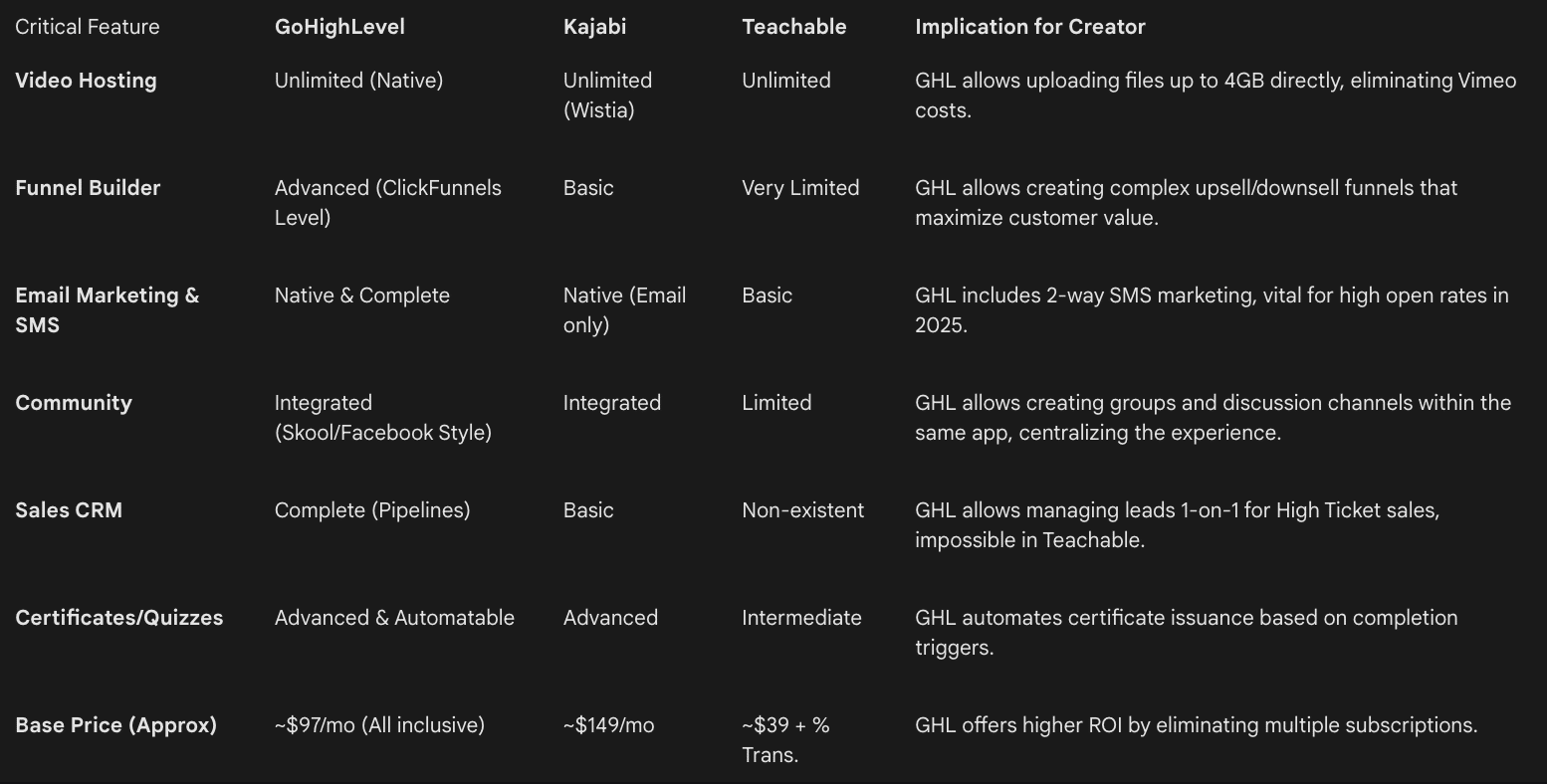
The Strategic Argument for GoHighLevel: Beyond cost savings, GHL’s competitive advantage lies in data unification. By having course progress, email history, purchases, and community activity in a single database (CRM), the creator can execute hyper-personalized automations. For example: “If student John completes Module 3 but does not log into the community for 2 days, send an automatic SMS asking if he needs help.” This level of granularity is impossible or very expensive to achieve with fragmented tools connected by Zapier.
For creators just starting, GHL frequently offers trial periods, allowing them to configure and launch the course before making the first payment, facilitating positive cash flow from the start.
Technical Implementation in GoHighLevel: From Setup to Launch.
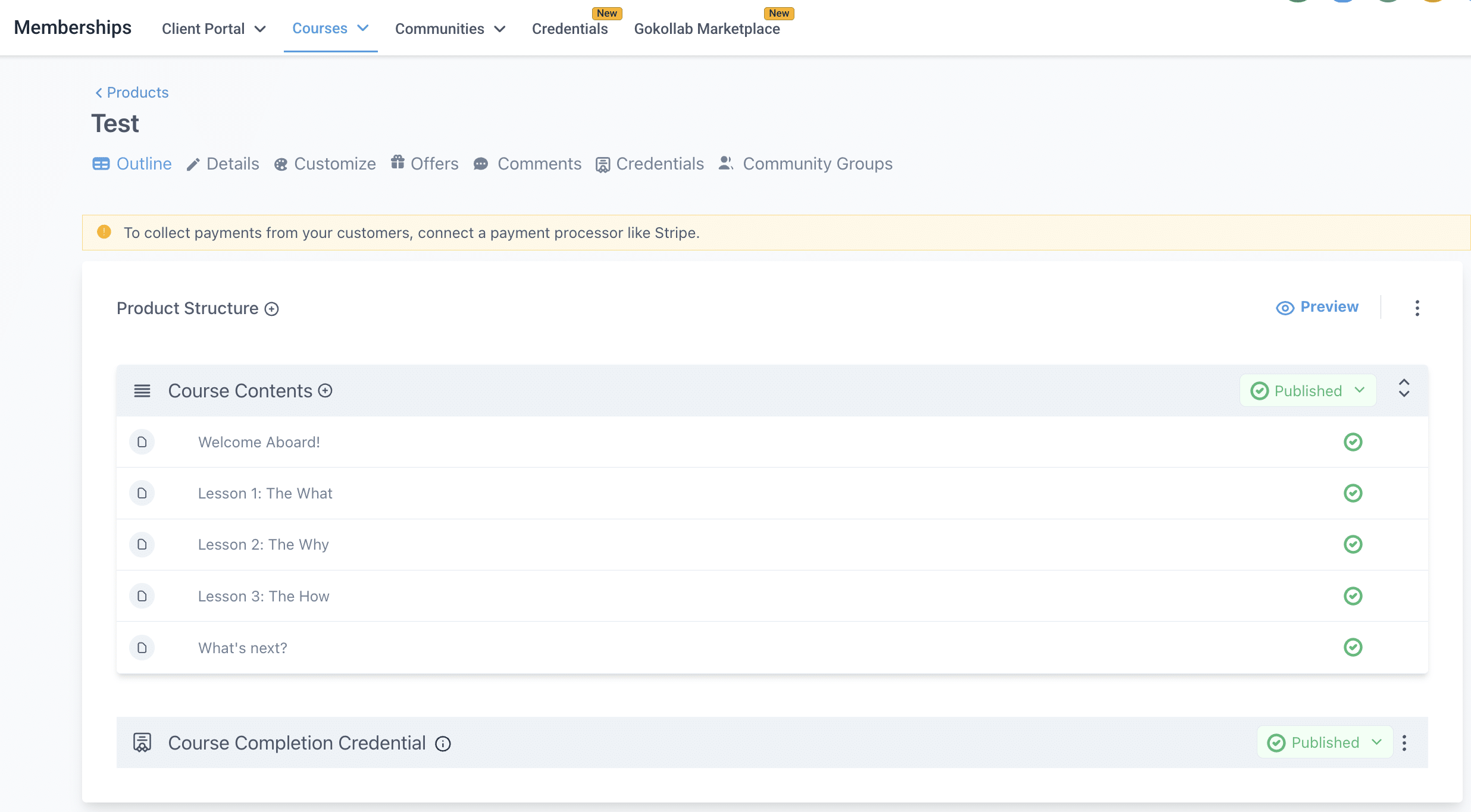
Implementing a course in GHL requires understanding its internal logic, which differs slightly from traditional LMS (Learning Management Systems) platforms.
Structure of “Products” and “Offers”
GHL separates content from the sales mechanism, which offers strategic flexibility.
-
Products: This is where the educational content lives (videos, texts, files). It is structured into Categories (Modules) and Posts (Lessons). The platform supports high-definition video uploads (up to 4GB) and allows customizing thumbnails and descriptions for each lesson.
-
Offers: This is the commercial vehicle. An “Offer” can contain one or several “Products.” This allows creating “Bundles.”
-
Strategy Example: You can create a “Basic” Offer ($97) that gives access only to the “Main Course” Product. Then, a “VIP” Offer ($197) that gives access to “Main Course” + “Bonus Course” + “Community Access.” There is no need to duplicate content; it is simply packaged differently.
-
Customization and User Experience (Course Studio 2.0)

With recent updates (Course Studio 2.0), GHL has drastically improved the aesthetics of the course player. It is now possible to choose visual themes that resemble Netflix or premium streaming platforms. Colors, fonts, and the navigation sidebar can be customized to match the creator’s brand exactly. Furthermore, the platform is completely responsive, ensuring students can consume content on mobile devices seamlessly.
Certificates and Assessment Automation
Learning validation is managed through Quizzes and Assignments.
-
Assessments: Can be inserted at the end of each lesson or module. It is possible to configure a passing threshold (e.g., 80%) that prevents advancement if not met, ensuring competence.
-
Certificates: GHL allows creating certificate templates with dynamic fields (Student Name, Date, Course Name). Through “Workflows,” automation can be set up: Trigger: “Course 100% completed” -> Action: “Generate PDF Certificate” -> Action: “Send Email with Attached Certificate”. This eliminates the manual administrative burden of issuing diplomas.
Community Integration
Instead of sending students to a Facebook Group (where there are distractions and ads), GHL allows creating private communities within the platform itself. Thematic channels can be created (e.g., “Introductions,” “Module 1 Questions,” “Wins”). The integration is total: a student can go from watching a lesson to commenting in the community with a single click, maintaining retention within the creator’s ecosystem.
Launch Strategy, Marketing, and Pricing.
Having the course built is only half the equation; the other half is customer acquisition.
Pricing Models and Course Economics
Pricing choice determines marketing strategy.
-
Low Ticket ($27 – $97): Impulse buys. Requires high traffic volume. Generally not profitable with direct paid advertising (Facebook Ads) unless there is a strong “backend.” Ideal for list building.
-
High Ticket ($497 – $2,000+): Requires higher trust and a longer sales process (webinars, phone calls). However, very few sales are needed to be profitable. Allows offering personalized support and high margins for advertising.
-
Subscription/Membership ($27 – $97/mo): Generates Monthly Recurring Revenue (MRR). The challenge is retention; new content must be created constantly to avoid churn.
Effective Sales Funnels
The traditional “brochure-style” website does not sell courses. An optimized sales funnel is required. In GHL, proven templates can be cloned that follow this structure:
-
Landing Page (Opt-in): Offers free value in exchange for contact info.
-
Sales Page (VSL – Video Sales Letter): A persuasive video explaining the problem and solution, followed by social proof and an irresistible offer.
-
Checkout with Order Bump: On the payment form, a checkbox to add a small complementary product (e.g., “Add PDF Templates for $17”). This immediately increases average cart value.
-
Upsell One-Click: After paying, a “one-time only” offer for a higher-tier product.
-
Thank You Page: Confirmation and access.
Email Marketing Sequences for Launch
Email remains the channel with the highest return on investment. A typical launch sequence lasts 5 to 10 days:
-
Anticipation Phase: Warn that “something is coming.” Share the story behind the course.
-
Opening Phase (Day 1): The cart is open. Explain the transformation.
-
Education Phase (Day 2-3): Overcome objections (e.g., “I don’t have time,” “I don’t have experience”). Show testimonials.
-
Scarcity Phase (Day 4-5): Warn that the special bonus or discount expires. Real urgency motivates action.
SEO and Organic Growth: Beyond Paid Advertising
To reduce dependence on paid ads, the course must be visible organically.
LSI Keyword Research and Content
It is not enough to attack obvious keywords like “cooking course.” Latent Semantic Indexing (LSI) must be used. This involves including conceptually related terms that Google associates with the expert topic. SEO tools can reveal these connections. Creating blog content or YouTube videos answering specific “long-tail” questions attracts qualified traffic with high purchase intent.
Schema Markup for FAQ
An advanced and underutilized technique is implementing structured data of the type FAQPage on the course sales page. This allows Frequently Asked Questions to appear expanded directly in Google search results, occupying more visual space on the screen and drastically increasing click-through rate (CTR). GoHighLevel allows inserting this custom code in its page builders.
Conclusion: The Path to Sustainability
Creating an online course in 2025 is an act of serious entrepreneurship that requires orchestrating multiple disciplines: educational psychology, audiovisual production, software engineering, and direct marketing. The technical barrier to entry has lowered thanks to platforms like GoHighLevel, but the quality barrier has risen.
Success belongs not to the one with the best content in isolation, but to the one with the best system for delivering that content and managing the relationship with the student.
The final recommendation for any aspiring creator is to adopt an “ecosystem” mindset: validate first, produce with professional standards, and host the business on a technological infrastructure that allows for growth without artificial limits. By consolidating tools and focusing on student transformation, the online course ceases to be a static digital product and becomes a dynamic and scalable business asset.